
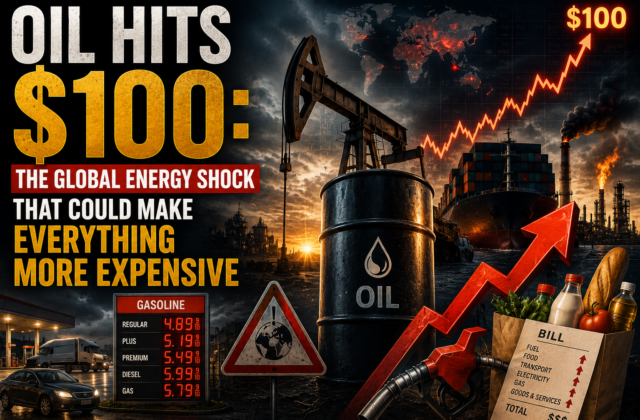
Oil Hits $100: The Global Energy Shock That Could Make Everything More Expensive
Oil Hits $100: The Global Energy Shock That Could Make Everything More Expensive A price level that global markets have been fearing has returned. Brent crude oil has climbed to $100 per barrel, a psychological and economic milestone that could have far-reaching consequences for households, businesses, governments, and financial markets worldwide. The rally has been...
TheBusinessNow
Jul 23, 2026 · 4 min Read
Key Highlights
- 🛢️ Brent crude oil has surged to $100 per barrel, a key psychological level for global energy markets.
- 🌍 Rising Red Sea shipping disruptions and Middle East tensions involving Iran are fueling supply concerns.
- 📈 Higher oil prices could increase fuel costs, transportation expenses, and global inflation.
- 🏦 Central banks, including the Federal Reserve and ECB, may face renewed pressure if energy-driven inflation persists.
- 💰 Energy companies could benefit, while airlines, logistics firms, and fuel-intensive industries may face higher costs.
- 📊 Investors are closely monitoring geopolitical developments and oil market volatility for signs of further price movements.
Oil Hits $100: The Global Energy Shock That Could Make Everything More Expensive
A price level that global markets have been fearing has returned.
Brent crude oil has climbed to $100 per barrel, a psychological and economic milestone that could have far-reaching consequences for households, businesses, governments, and financial markets worldwide.
The rally has been driven by growing supply concerns linked to disruptions in the Red Sea shipping corridor and escalating geopolitical tensions involving Iran, raising fears that global energy supplies could become tighter in the months ahead.
While oil has crossed the $100 mark before, the timing of this surge is especially significant. Major economies are still battling inflation, central banks remain cautious on interest rates, and global growth is already facing multiple headwinds.
The question investors are now asking is simple: Could $100 oil become the next global inflation shock?
Brent Crude Crosses a Critical Level
Oil traders closely monitor Brent crude because it serves as the benchmark for pricing much of the world’s internationally traded oil.
Latest Market Snapshot
| Indicator | Latest |
|---|---|
| Brent Crude | $100 per barrel |
| Main Driver | Supply concerns |
| Key Factors | Red Sea disruptions, Middle East tensions |
Crossing $100 is not just symbolic—it changes market expectations for inflation, corporate costs, and consumer spending.
Why Oil Prices Are Rising
Several developments are contributing to the sharp increase.
1. Red Sea Shipping Disruptions
The Red Sea remains one of the world’s busiest maritime trade routes.
Any disruption increases:
- Shipping costs
- Insurance premiums
- Delivery delays
- Energy transportation risks
Since millions of barrels of oil move through nearby sea lanes every day, even temporary disruptions can tighten supply expectations.
2. Rising Middle East Tensions
Markets remain highly sensitive to developments involving Iran and regional security.
Even without actual supply losses, the possibility of escalating tensions can increase the “geopolitical risk premium” built into oil prices.
Traders often price in future risks before any physical disruption occurs.
3. Supply Concerns
Oil markets operate on expectations.
If investors believe future supplies could tighten, prices often rise well before shortages materialize.
This explains why geopolitical headlines can move crude markets within minutes.
Why $100 Oil Matters
Oil influences almost every sector of the global economy.
Higher crude prices eventually affect:
- Petrol and diesel
- Airline tickets
- Freight transportation
- Food prices
- Manufacturing costs
- Electricity generation in some regions
- Consumer goods
Businesses typically pass at least part of these higher costs to consumers.
Could Inflation Return?
One of the biggest concerns surrounding $100 oil is inflation.
Higher energy prices increase production and transportation costs across the economy.
This can lead to:
- More expensive groceries
- Higher logistics costs
- Increased travel expenses
- Rising industrial input costs
For central banks that have spent years trying to bring inflation under control, another energy shock would complicate policy decisions.
What It Means for Central Banks
The Federal Reserve, European Central Bank, and other policymakers have been closely monitoring inflation trends.
A sustained rise in oil prices could:
- Delay expected interest-rate cuts.
- Keep borrowing costs elevated.
- Increase inflation expectations.
- Affect bond markets.
Energy prices are not the only driver of inflation, but they are among the most visible.
Winners and Losers
Potential Winners
- Oil producers
- Energy companies
- Oil-exporting countries
- Some commodity-linked stocks
Potential Losers
- Airlines
- Transport companies
- Chemical manufacturers
- Retailers facing higher costs
- Consumers paying more for fuel
Market reactions will depend on how long oil remains above $100.
What It Means for Investors
Historically, sustained oil rallies have influenced:
- Stock market performance
- Bond yields
- Gold prices
- Currency markets
- Inflation expectations
Some investors rotate toward energy stocks during periods of rising crude prices, while others become more defensive if higher energy costs begin slowing economic activity.
Could Gold Benefit Too?
Periods of geopolitical uncertainty often increase demand for traditional safe-haven assets.
If rising oil contributes to higher inflation or greater market volatility, investors may also pay closer attention to:
- Gold
- Government bonds
- Defensive equities
- The U.S. dollar
However, the relationship between oil and gold depends on broader market conditions and central bank policy.
Global Economic Impact
The world economy remains interconnected.
A sustained increase in oil prices could influence:
- Global inflation
- Consumer spending
- Corporate profit margins
- Shipping costs
- International trade
- Emerging-market economies that rely on imported energy
Countries heavily dependent on oil imports could experience greater pressure on trade balances and government finances.
What Could Happen Next?
Several scenarios remain possible.
Scenario 1: Tensions Ease
If geopolitical risks decline and shipping routes normalize, oil prices could stabilize.
Scenario 2: Supply Risks Persist
Continued disruptions may keep prices elevated, increasing inflationary pressure.
Scenario 3: Physical Supply Disruptions
If actual production or exports are affected, markets could experience greater volatility than seen so far.
Why Markets Are Watching Every Headline
Oil prices react not only to supply and demand but also to expectations.
Statements from governments, shipping developments, sanctions, military activity, and producer decisions can all move crude prices rapidly.
That makes geopolitical developments one of the most closely watched drivers of today’s energy market.
Final Analysis
Brent crude’s rise to $100 per barrel is more than just another commodity milestone. It reflects growing concerns about energy security, geopolitical risks, and the resilience of the global economy.
Whether the move proves temporary or marks the beginning of a longer period of elevated prices will depend on how events unfold in the Middle East, the security of global shipping routes, and future supply decisions by major oil-producing nations.
For consumers, businesses, and investors alike, one thing is clear: energy prices remain one of the most powerful forces shaping inflation, interest rates, and financial markets.
If oil stays near—or above—$100 for an extended period, the ripple effects could extend well beyond the fuel pump, influencing everything from grocery bills and airline fares to central bank decisions and global economic growth.
❓ Frequently Asked Questions (FAQs)
1. Why did Brent crude oil reach $100 per barrel?
Brent crude rose due to concerns over potential supply disruptions linked to Red Sea shipping risks and escalating geopolitical tensions in the Middle East.
2. Why is $100 oil considered important?
The $100 level is both a psychological and economic benchmark. Sustained prices at or above this level can affect inflation, fuel costs, and global financial markets.
3. Will gasoline and diesel prices increase?
If crude oil remains elevated for an extended period, fuel prices in many countries could gradually rise, although local taxes, refining costs, and currency movements also play a role.
4. Could higher oil prices affect inflation?
Yes. Higher energy costs can increase transportation, manufacturing, and logistics expenses, which may contribute to broader inflationary pressures.
5. How could $100 oil affect stock markets?
Energy producers may benefit from higher prices, while sectors such as airlines, transportation, and manufacturing could face higher operating costs. Overall market reactions depend on the duration of the price increase and broader economic conditions.
6. What should investors watch next?
Key factors include developments in the Middle East, Red Sea shipping security, OPEC+ production decisions, U.S. crude inventory data, and inflation indicators from major economies.
🌐 About The Business Now
The Business Now is a global business and finance news platform delivering in-depth coverage of markets, investing, geopolitics, technology, AI, energy, commodities, and the world economy. We combine timely reporting with data-driven analysis to explain not only what is happening, but why it matters to investors, businesses, and readers worldwide.
Keep reading
Related Articles
 Crypto
₿ Bitcoin Breaks Above $72,000: Why Trump’s Crypto Push Is Sending Crypto Stocks Higher
Bitcoin’s $72,000 Move Is Bigger Than Bitcoin A typical crypto headline would be: Bitcoin jumps above $72,000. But that misses the most important part of today’s move. The interesting part is the simultaneous rally in: Bitcoin ↓ Coinbase ↓ Strategy ↓ Circle ↓ Robinhood ↓ Bitcoin miners ↓ Crypto infrastructure That tells us investors aren’t...
 Markets
U.S. Treasury Doubles Bond Buybacks: Why Markets Are Still Worried About Rising Yields
The Treasury Just Sent Two Messages to Wall Street At first glance, this looks like a straightforward market-support operation. Treasury says: We want to improve liquidity in longer-dated Treasury securities. Investors hear: Washington is increasingly concerned about the rise in long-term borrowing costs. And that second interpretation is what makes this story important. The Treasury...
 Commodities
Oil Nears $95: Could the Iran War Trigger a New U.S. Inflation Shock?
Oil at $95 Is Not the Real Story A crude-oil headline is easy to write: “Oil prices rise as Iran tensions escalate.” Reuters, Bloomberg, CNBC and WSJ can publish that story within minutes. But for TheBusinessNow, that isn’t enough. The bigger question is: What happens to the American economy if oil stays near $95 —...
Comments (0)