
Bank of England Holds Rates at 3.75%: Why the UK Central Bank Is Still Worried About Inflation
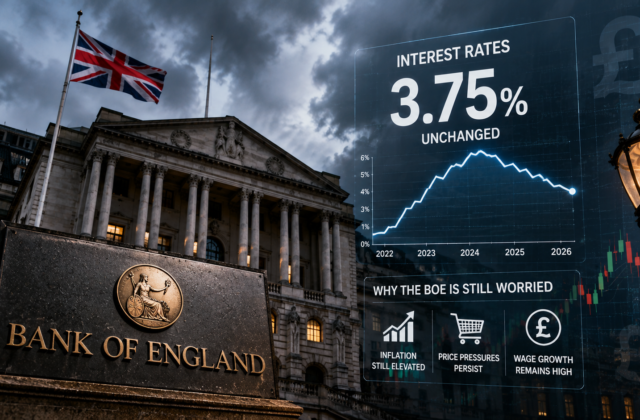
Bank of England Holds Rates at 3.75%: Why the UK Central Bank Is Still Worried About Inflation The Bank of England (BoE) has kept its benchmark interest rate unchanged at 3.75%, matching market expectations and marking the fifth consecutive meeting at which the rate has remained at this level. The decision comes as UK inflation...
John Mark
Jul 30, 2026 · 3 min Read
Key Highlights
- 🏦 Bank of England holds Bank Rate at 3.75%.
- 📊 The decision was made by a 6–3 vote of the Monetary Policy Committee.
- 📈 Three policymakers wanted a 0.25 percentage-point increase.
- 🇬🇧 UK inflation fell to 2.6% in June, but remains above the BoE's 2% target.
- ⚡ Higher energy prices remain a major inflation risk.
- 📉 The BoE's central scenario sees inflation peaking around 3.2% in Q4 2026.
- 💷 Markets are now watching closely for clues about the next rate move.
Bank of England Holds Rates at 3.75%: Why the UK Central Bank Is Still Worried About Inflation
The Bank of England (BoE) has kept its benchmark interest rate unchanged at 3.75%, matching market expectations and marking the fifth consecutive meeting at which the rate has remained at this level. The decision comes as UK inflation has eased, but policymakers remain concerned that higher energy prices could push inflation higher again.
Why Did the Bank of England Hold Interest Rates at 3.75%?
The Bank of England decided to leave its benchmark interest rate unchanged at 3.75% on July 30.
The decision was not completely unanimous. Six members of the Monetary Policy Committee voted to maintain the rate, while three preferred a 25-basis-point increase.
That split is important.
It shows that policymakers are increasingly divided over whether inflation is cooling sufficiently or whether renewed energy-price pressures could create another inflation problem.
The BoE therefore chose to remain cautious rather than immediately cut rates or raise them.
UK Inflation Falls, But the Inflation Battle Isn’t Over
One reason markets had expected the BoE to hold rates was the recent improvement in UK inflation.
Consumer price inflation fell to 2.6% in June, down from 2.8% previously. However, inflation has remained above the Bank’s 2% target for 21 consecutive months, according to AP.
That creates a difficult policy environment.
The central bank wants inflation to return sustainably to 2%, but raising interest rates too aggressively could weaken economic activity.
At the same time, leaving rates too low could allow inflationary pressures to become persistent.
Why Are Three BoE Policymakers Calling for a Rate Hike?
The three dissenting policymakers were concerned about the possibility that inflation pressures could remain stronger than expected.
Energy prices are particularly important.
The ongoing geopolitical instability in the Middle East has pushed oil and gas prices higher, increasing the potential cost of transportation, manufacturing and household energy.
The BoE’s July scenarios show how serious that risk could become.
Under its central scenario, inflation is projected to peak at around 3.2% in Q4 2026 before gradually falling toward 1.7% in early 2028.
Under a more adverse scenario, however, inflation could reach 4.1% in Q3 2027 if energy prices remain significantly elevated.
The Middle East Conflict Is Creating a New Problem for the BoE
The Bank of England is facing an unusual combination of risks.
On one side, weaker economic activity and a softer labour market could reduce inflationary pressure.
On the other, higher energy prices caused by geopolitical disruption could push inflation higher.
The BoE has previously warned that an energy shock can create a difficult trade-off between inflation and economic growth. Its June policy statement noted that the impact of higher energy prices remained uncertain and that persistent energy costs could create second-round effects through wages and prices.
That tension remains central to today’s decision.
What Does the 3.75% Rate Mean for UK Households?
For households, today’s decision means there is no immediate change in the Bank Rate.
That matters particularly for borrowers with mortgages or other variable-rate debt.
A rate hold also means savers are not immediately facing another reduction in the interest rates available on savings products.
However, the impact on consumers goes beyond the Bank Rate itself.
Mortgage rates are also influenced by financial-market expectations, swap rates and competition between lenders.
So even without a BoE rate change, mortgage pricing can still move.
What Does It Mean for Businesses?
UK businesses are also watching the decision closely.
Higher interest rates generally make borrowing more expensive, potentially reducing investment and expansion.
But businesses also face higher input costs when energy prices rise.
That creates a double challenge:
Higher borrowing costs + higher operating costs = pressure on business margins.
Companies with large debt loads may be particularly sensitive to interest-rate expectations.
Meanwhile, businesses exposed to energy-intensive manufacturing, transport or logistics could face additional pressure if oil and gas prices remain elevated.
Could the Bank of England Raise Rates Again?
Today’s decision does not guarantee that the next move will be a cut.
The 6–3 vote shows that some policymakers already believe tighter policy may be necessary if inflation becomes more persistent.
The direction of the next move will likely depend on:
- UK inflation data
- Wage growth
- Labour-market conditions
- Energy prices
- Economic growth
- Consumer spending
- Global geopolitical developments
If inflation continues falling and economic activity weakens, rate-cut expectations could return.
But if energy prices remain elevated and inflation expectations rise, another rate increase could come back into focus.
What Does the BoE Decision Mean for the Pound?
The Bank of England’s decision can influence the British pound because interest-rate expectations are closely watched by currency traders.
A more hawkish BoE can support sterling if markets expect UK rates to remain higher for longer.
Conversely, expectations of future rate cuts can put pressure on the pound.
Today’s split vote could therefore be important for currency markets because it signals that the MPC is not uniformly convinced that the inflation threat has disappeared.
What Does This Mean for Gold Prices?
The BoE decision also matters indirectly for global commodities and precious metals.
Gold prices respond to several factors, including interest-rate expectations, real yields, the U.S. dollar and geopolitical risk.
When geopolitical tensions increase, investors often pay greater attention to gold as a potential safe-haven asset.
For readers tracking the precious-metals market, GoldPriceNow.in provides live gold prices, historical information and gold-related market tools.
The interaction between central-bank policy, inflation and geopolitical risk remains particularly important for gold investors.
What Happens Next for the Bank of England?
The biggest question is whether today’s rate hold represents a pause before another cut—or a prolonged period of restrictive monetary policy.
The BoE’s central scenario currently sees inflation eventually returning toward its 2% objective, but policymakers are clearly concerned about the possibility of renewed energy-driven inflation.
The 6–3 vote is therefore arguably more important than the headline rate itself.
It shows that the debate inside the MPC is becoming more complicated.
The Bigger Picture
The Bank of England is attempting to navigate three major forces at the same time:
🇬🇧 UK inflation
⚡ Energy-price pressures
📉 Economic-growth risks
The decision to keep rates at 3.75% suggests policymakers believe there is currently enough evidence to wait for more economic data rather than immediately changing policy.
But the three votes for a rate increase show that the inflation threat has not disappeared.
If energy prices remain elevated, the BoE could face a difficult choice between protecting its inflation target and supporting economic growth.
Conclusion
The Bank of England has held interest rates at 3.75%, but today’s decision is far from a simple “no change” story.
The 6–3 vote reveals a divided Monetary Policy Committee, with three members preferring a rate increase. At the same time, UK inflation has fallen to 2.6%, providing some evidence that previous monetary tightening is working.
The biggest threat now is whether higher energy prices and geopolitical instability reignite inflation.
For UK households, businesses, investors and currency traders, the next inflation and economic-growth figures could be just as important as today’s rate decision.
For now, the Bank of England is holding at 3.75%—but the debate over the UK’s next rate move is clearly not over.
❓ FAQs
What is the Bank of England interest rate today?
The Bank of England has kept its benchmark Bank Rate at 3.75% as of July 30, 2026.
Did the Bank of England cut interest rates?
No. The BoE held rates unchanged at 3.75%.
Why did the Bank of England hold rates?
The decision reflects the balance between falling UK inflation and continuing risks from energy prices and geopolitical uncertainty.
Was the decision unanimous?
No. The MPC voted 6–3 to hold rates, with three members preferring a 0.25 percentage-point increase.
What is UK inflation now?
UK CPI inflation fell to 2.6% in June 2026, according to reporting on the latest BoE decision.
Could the Bank of England raise rates?
Yes. Today’s 6–3 vote shows that some policymakers believe additional tightening could be necessary if inflationary pressures persist.
What does the rate decision mean for mortgages?
There is no immediate change to the Bank Rate, but mortgage rates can still change based on market expectations, funding costs and lender competition.
Does the Bank of England decision affect gold?
Central-bank policy can influence gold through interest-rate expectations, currency movements and investor demand. Geopolitical risk can also affect safe-haven demand.
📰 About The Business Now
The Business Now is a digital news and business publication covering global business, finance, markets, politics, technology, AI, commodities and major world events.
Our coverage focuses on breaking developments while providing context around what the news means for markets, businesses and investors.
👉 Read more business and market news at The Business Now
🪙 Check Live Gold Prices
Want to track the latest precious-metal markets?
👉 Check Live Gold Prices at GoldPriceNow.in
GoldPriceNow.in covers live gold prices, silver prices, historical market data, gold calculators and precious-metals updates.
🌐 External Resources
- Bank of England — Official central-bank information and monetary-policy decisions.
- Reuters – Bank of England July Decision — Coverage of the July 2026 decision and the BoE’s economic scenarios.
- AP News – Bank of England Rate Decision — Latest reporting on the 3.75% rate hold and MPC vote.
- GoldPriceNow.in — Live gold and precious-metals prices.
- The Business Now — Business, finance and global news coverage.
Keep reading
Related Articles
 Crypto
₿ Bitcoin Breaks Above $72,000: Why Trump’s Crypto Push Is Sending Crypto Stocks Higher
Bitcoin’s $72,000 Move Is Bigger Than Bitcoin A typical crypto headline would be: Bitcoin jumps above $72,000. But that misses the most important part of today’s move. The interesting part is the simultaneous rally in: Bitcoin ↓ Coinbase ↓ Strategy ↓ Circle ↓ Robinhood ↓ Bitcoin miners ↓ Crypto infrastructure That tells us investors aren’t...
 Markets
U.S. Treasury Doubles Bond Buybacks: Why Markets Are Still Worried About Rising Yields
The Treasury Just Sent Two Messages to Wall Street At first glance, this looks like a straightforward market-support operation. Treasury says: We want to improve liquidity in longer-dated Treasury securities. Investors hear: Washington is increasingly concerned about the rise in long-term borrowing costs. And that second interpretation is what makes this story important. The Treasury...
 Commodities
Oil Nears $95: Could the Iran War Trigger a New U.S. Inflation Shock?
Oil at $95 Is Not the Real Story A crude-oil headline is easy to write: “Oil prices rise as Iran tensions escalate.” Reuters, Bloomberg, CNBC and WSJ can publish that story within minutes. But for TheBusinessNow, that isn’t enough. The bigger question is: What happens to the American economy if oil stays near $95 —...
Comments (0)