
AI Leverage Warning: The Same Big Tech Stocks Are Powering a Growing Market of Leveraged ETFs
AI Leverage Warning: The Same Big Tech Stocks Are Powering a Growing Market of Leveraged ETFs AI stocks have become more than a dominant force in the equity market—they are increasingly sitting underneath leveraged exchange-traded products that can magnify daily gains and losses. That concentration is creating a new source of market sensitivity: when the...
James
Aug 11, 2026 · 4 min Read
Key Highlights
- 🤖 AI stocks are increasingly at the center of leveraged equity exposure.
- 📈 Leveraged ETFs can seek to deliver multiples of an underlying stock or index's daily performance.
- ⚠️ Daily leverage can amplify losses just as quickly as gains.
- 🔄 Compounding and daily rebalancing can cause long-term returns to diverge significantly from the advertised multiple.
- 📊 SEC filings for leveraged AI-related ETFs explicitly warn that higher volatility and longer holding periods can magnify the effects of compounding.
- 🧠 Nvidia, AMD, Alphabet and other major technology companies now have leveraged ETF products linked directly to their daily share-price movements.
- 🌪️ A concentrated AI selloff could therefore have consequences beyond conventional technology portfolios.
AI Leverage Warning: The Same Big Tech Stocks Are Powering a Growing Market of Leveraged ETFs
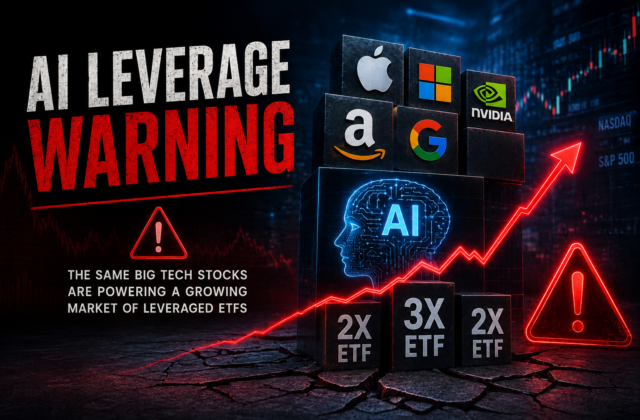
AI stocks have become more than a dominant force in the equity market—they are increasingly sitting underneath leveraged exchange-traded products that can magnify daily gains and losses. That concentration is creating a new source of market sensitivity: when the same handful of AI-linked companies move sharply, the impact can spread beyond ordinary stock portfolios into leveraged products tied to those names.
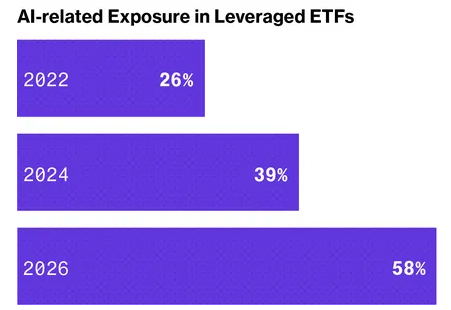
Bloomberg’s latest Big Take highlights how a growing share of equity leverage is concentrated around major AI companies, many of which have already experienced unusually large price swings. Bloomberg’s Big Take on AI-Dominated Leveraged ETFs
The issue isn’t simply that leveraged ETFs exist.
The bigger concern is concentration.
When investors, funds and trading strategies increasingly use leveraged products linked to the same AI leaders, a sharp move in those underlying stocks can potentially transmit volatility through several layers of the market.
And because many leveraged ETFs reset their exposure daily, their long-term performance can differ dramatically from simply multiplying the underlying stock’s eventual return.AI Leverage Warning: The Same Big Tech Stocks Are Powering a Growing Market of Leveraged ETFs
AI stocks have become more than a dominant force in the equity market—they are increasingly sitting underneath leveraged exchange-traded products that can magnify daily gains and losses. That concentration is creating a new source of market sensitivity: when the same handful of AI-linked companies move sharply, the impact can spread beyond ordinary stock portfolios into leveraged products tied to those names.
Bloomberg’s latest Big Take highlights how a growing share of equity leverage is concentrated around major AI companies, many of which have already experienced unusually large price swings. Bloomberg’s Big Take on AI-Dominated Leveraged ETFs
The issue isn’t simply that leveraged ETFs exist.
The bigger concern is concentration.
When investors, funds and trading strategies increasingly use leveraged products linked to the same AI leaders, a sharp move in those underlying stocks can potentially transmit volatility through several layers of the market.
And because many leveraged ETFs reset their exposure daily, their long-term performance can differ dramatically from simply multiplying the underlying stock’s eventual return.
📈 Why Leveraged ETFs Are Becoming So Important
A conventional ETF might simply track an index or basket of stocks.
A leveraged ETF is different.
Instead of attempting to match the daily performance of an underlying asset, it may target 200% or another multiple of that daily move.
For example, if an underlying stock rises 5% in one trading session, a 2X leveraged product might target approximately a 10% gain before fees and other factors.
But if the stock falls 5%, the leveraged product could target approximately a 10% decline.
That sounds simple.
The complication begins when the position is held for multiple trading sessions.
⚠️ The Daily Reset Problem Investors Often Miss
The most important word in leveraged ETF disclosures is:
Daily.
A 2X ETF generally seeks to provide twice the daily return—not twice the return over an entire month, year or other holding period.
The SEC filings for leveraged AI products explicitly warn investors about this distinction. For example, the Direxion Daily Robotics, Artificial Intelligence & Automation Index Bull 2X ETF states that its objective is daily leveraged performance and that longer holding periods can produce results substantially different from 200% of the underlying index’s return.
This happens because of compounding.
🧮 A Simple Example of How Compounding Can Hurt
Imagine an AI stock starts at $100.
Day 1:
Stock falls 10% → $90
A 2X leveraged product could fall approximately 20%.
Day 2:
The stock rises 11.11%.
It returns to:
$100
The stock has therefore finished the two-day period exactly where it started.
But the leveraged ETF doesn’t necessarily return to its starting value.
After a 20% loss, a 22.22% gain is required to recover the same amount:
$100 → $80 → $97.78
The underlying asset ended flat.
The leveraged product lost money.
This is why volatility itself matters.
🌪️ Volatility Can Become the Real Enemy
The SEC warns that higher volatility and longer holding periods increase the impact of compounding for leveraged products.
This creates an unusual situation.
An investor can correctly predict the long-term direction of an AI stock and still experience disappointing results in a daily leveraged ETF.
Why?
Because the path matters.
A smooth upward trend and a violent sequence of gains and losses are not equivalent for a daily-reset leveraged product.
🤖 Why AI Creates a Particularly Interesting Risk
AI has become one of the dominant investment narratives of the current market cycle.
The sector includes companies involved in:
- advanced processors;
- cloud computing;
- AI models;
- data centers;
- networking;
- enterprise software;
- robotics;
- semiconductor manufacturing;
- and AI infrastructure.
That means investors can gain AI exposure through individual stocks, broad technology ETFs, thematic ETFs and leveraged products.
The result is a market where the same underlying AI companies can appear in multiple investment strategies simultaneously.
That is the concentration Bloomberg is highlighting.
🧠 Nvidia, AMD and Other AI Leaders Are Now Directly Linked to Leveraged Products
This isn’t theoretical.
The SEC has filings for products designed to provide daily leveraged exposure to individual technology companies.
For example:
- Direxion Daily NVDA Bull 2X ETF (NVDU) seeks 200% of Nvidia’s daily performance.
- Leverage Shares 2X Long AMD Daily ETF (AMDG) seeks 200% of AMD’s daily performance.
- Leverage Shares 2X Long GOOGL Daily ETF (GOOL) seeks 200% of Alphabet’s daily performance.
- Direxion Daily Robotics, Artificial Intelligence & Automation Index Bull 2X ETF (UBOT) seeks 200% of the daily performance of its underlying AI/robotics index.
This doesn’t mean these products are inherently bad.
It means they are specialized instruments with materially different risk characteristics from conventional ETFs.
💥 What Happens During an AI Selloff?
Consider a hypothetical scenario.
Suppose several major AI stocks suddenly fall because investors become concerned about:
- slowing AI revenue;
- excessive valuations;
- weaker-than-expected earnings;
- reduced capital expenditure;
- chip demand;
- interest rates;
- or an economic slowdown.
The initial decline hits the underlying stocks.
But leveraged products tied to those stocks can experience a much larger daily percentage move.
If volatility persists, daily compounding can make the damage more severe.
This is why a concentrated AI selloff can potentially become a market-structure issue, rather than simply a stock-picking event.
🏦 The AI Investment Boom Is Bigger Than Stocks
Another important part of the story is that AI investment increasingly involves enormous spending on infrastructure.
Companies are spending heavily on:
- data centers;
- GPUs and accelerators;
- networking equipment;
- electricity;
- cloud infrastructure;
- cooling systems;
- and model development.
Recent financial-stability analysis has highlighted how estimates for AI hyperscalers’ future capital expenditure have risen dramatically, with 2028 consensus estimates reportedly moving above $1 trillion.
That creates another question for investors:
How much future AI growth is already priced into today’s valuations?
If earnings growth catches up with expectations, the leverage cycle may remain supportive.
If expectations fall faster than earnings, the reversal could be much more violent.
📊 AI Valuations vs. AI Fundamentals
This is where the market’s next phase could become particularly important.
The AI trade has moved from simply asking:
“Will AI grow?”
to:
“Will AI grow fast enough to justify the amount of money being invested in it?”
That’s a much harder question.
A company can report strong revenue growth and still see its stock decline if investors expected even stronger results.
The same principle applies to the wider AI ecosystem.
🧨 Why Market Concentration Matters
Imagine a portfolio containing:
- a major AI stock;
- a technology ETF;
- an AI thematic ETF;
- and a leveraged ETF linked to the same AI stock.
At first glance, these appear to be four separate investments.
Economically, however, they may have a significant amount of exposure to the same underlying AI trade.
That can create hidden concentration.
Investors may therefore underestimate how much of their portfolio depends on a small group of companies continuing to perform well.
📉 Could Leveraged ETFs Amplify a Market Selloff?
They can amplify the investor’s exposure to daily movements.
But it would be too simplistic to say leveraged ETFs automatically cause every market decline.
Market liquidity, fund structure, hedging activity, derivatives markets and investor behavior all matter.
The important point is that leveraged products can create larger sensitivity to underlying price movements.
The SEC has specifically highlighted risks associated with leveraged and inverse ETPs, including potential price dislocations during periods of market stress.
🔄 The Rebalancing Effect
Daily leveraged ETFs generally have to adjust their exposure so that they can continue targeting their stated daily multiple.
That means the fund’s exposure changes as the underlying market moves.
During normal markets, this mechanism can operate without attracting much attention.
During extreme volatility, however, large underlying moves can force significant adjustments.
That is one reason investors should understand the mechanics before treating a leveraged ETF as a simple long-term substitute for the underlying stock.
📱 Why Retail Investors Are Paying Attention
Leveraged ETFs have made it relatively easy for individual investors to obtain amplified exposure without directly using margin in a traditional brokerage account.
That accessibility is one reason these products can become popular during strong bull markets.
When an AI stock rises sharply, a 2X product can appear extremely attractive.
The danger comes when the same investor assumes:
“If I believe in AI for the next five years, I should hold a 2X AI ETF for five years.”
That conclusion does not necessarily follow.
Daily leveraged products are designed around daily objectives, not necessarily long-term tracking of a multiple of cumulative returns.
🧠 AI Is Also Changing How Economists Measure the Economy
The leveraged-ETF story is happening alongside another important development: AI is becoming increasingly important to how economists and analysts interpret inflation and economic growth.
Bloomberg has separately examined how AI is becoming essential for measuring U.S. inflation and growth beyond traditional data such as CPI. Bloomberg: AI and U.S. inflation and growth
That illustrates just how deeply AI is moving into financial markets.
It is no longer simply a technology-sector story.
AI increasingly influences:
corporate investment → productivity → employment → inflation measurement → market valuations → portfolio construction
🧑💻 Zuckerberg’s AI Vision Adds Another Layer
Meta CEO Mark Zuckerberg has also outlined an aggressive vision for AI, emphasizing what he describes as personal superintelligence and a future in which AI agents assist individuals and businesses.
His 6,500-word manifesto argues that AI could create new forms of entrepreneurship and productivity rather than simply eliminating jobs. He also advocates open-weight AI, greater user control and earlier cooperation between AI companies and governments.
That bullish vision helps explain why investors continue to assign enormous expectations to AI.
But expectations are also what make markets vulnerable.
🔮 AI Leveraged ETF Outlook: What Investors Should Watch
The next stage of the AI trade could depend on several factors.
1. Earnings growth
AI companies need to continue producing strong financial results.
2. Capital expenditure
Investors will increasingly ask whether massive AI infrastructure spending is generating sufficient returns.
3. Interest rates
Higher rates can put pressure on high-growth technology valuations.
4. Volatility
Sharp daily swings can be particularly damaging to daily leveraged products because of compounding.
5. Market concentration
The more investment exposure that becomes concentrated in the same AI names, the more important those companies become to broader market stability.
🟢 Bull Case for AI
The bullish argument is straightforward.
If AI adoption accelerates:
- enterprise spending increases;
- AI infrastructure demand remains strong;
- semiconductor sales grow;
- cloud revenue expands;
- productivity improves;
- and AI companies generate substantially higher profits.
In that scenario, the AI investment cycle could continue expanding.
🔴 Bear Case for AI
The bearish scenario is not necessarily that AI disappears.
It could simply be that expectations get ahead of reality.
If investors begin questioning:
- enormous capital expenditure;
- stretched valuations;
- monetization timelines;
- competitive pressure;
- energy requirements;
- or the return on AI infrastructure,
the market could reprice even companies that continue growing.
For leveraged ETFs, that type of volatility can be particularly challenging.
🏆 Bottom Line
The biggest risk in the AI market may no longer be simply owning an AI stock. It may be how much leverage and concentration has accumulated around the same group of AI companies.
Bloomberg’s analysis highlights the growing role of AI names in leveraged ETFs, while SEC filings show just how differently these products behave from conventional investments.
The critical distinction is daily leverage versus long-term performance.
A 2X leveraged ETF is not automatically a 2X version of an AI stock over an entire investment period.
Volatility and compounding can dramatically change the outcome.
For investors, the lesson is simple:
The AI boom may still have room to run—but leverage can make both the upside and the eventual correction much more extreme.
❓ FAQs
What are leveraged ETFs?
Leveraged ETFs are exchange-traded products designed to seek a multiple of an underlying asset’s daily performance.
Are leveraged AI ETFs the same as normal AI ETFs?
No. A conventional AI ETF may track a basket of companies, while a leveraged AI ETF seeks amplified daily exposure and therefore carries substantially different risks.
Why are AI leveraged ETFs risky?
Leverage magnifies daily movements. Volatility and daily compounding can also cause long-term performance to diverge significantly from the stated multiple.
Can a leveraged ETF lose money even if the underlying stock eventually rises?
Yes. Because of daily compounding, the sequence of gains and losses matters. A volatile path can produce losses even when the underlying asset ultimately recovers.
What does 2X daily leverage mean?
A 2X daily product generally seeks approximately twice the underlying asset’s one-day percentage move, before fees and other factors.
Is a leveraged AI ETF suitable for long-term investors?
Not necessarily. Fund prospectuses explicitly state that these products are designed for investors who understand leverage, monitor their positions and understand the effects of daily compounding.
Why is AI concentration becoming a market concern?
Because the same large AI companies can appear across individual stocks, broad indexes, thematic ETFs and leveraged products, potentially creating more interconnected exposure to the same underlying names.
Does this mean an AI crash is coming?
No. The analysis highlights a risk, not a prediction that an AI crash is inevitable.
What should investors watch?
Watch AI earnings, capital expenditure, valuation, interest rates, semiconductor demand, volatility and flows into leveraged products.
🪙 Gold Price Today — Live Market Check
The AI-leverage story also matters to gold investors because a major technology-market correction can influence:
- safe-haven demand;
- Treasury yields;
- the U.S. dollar;
- Federal Reserve expectations;
- and overall risk appetite.
For the latest live gold price, 24K/22K rates and gold calculator, check:
GoldPriceNow.in — Live Gold Price & Calculator
Live-price note: I could not reliably retrieve the current GoldPriceNow.in quote in this web check, so I have not inserted an unverified ₹/gram figure.
🌐 Key Resources
- Bloomberg — AI-Dominated Leveraged ETFs Are Rattling Markets — Primary source for the market-concentration story.
- Bloomberg — AI and U.S. Inflation & Growth — Related analysis of AI’s growing role in economic measurement.
- Bloomberg — Zuckerberg’s AI Manifesto — Related AI strategy and policy discussion.
- SEC — Direxion Daily AI & Big Data Bear 2X ETF Prospectus — Official disclosure on daily leverage, volatility and compounding.
- SEC — Direxion Robotics, AI & Automation Bull 2X ETF Prospectus — Official leveraged-AI ETF risk disclosure.
- SEC — Direxion Daily NVDA Bull 2X ETF Prospectus — Example of daily leveraged exposure to Nvidia.
- GoldPriceNow.in — Live Gold Price & Calculator — Live gold-market reference.
Keep reading
Related Articles
 Crypto
₿ Bitcoin Breaks Above $72,000: Why Trump’s Crypto Push Is Sending Crypto Stocks Higher
Bitcoin’s $72,000 Move Is Bigger Than Bitcoin A typical crypto headline would be: Bitcoin jumps above $72,000. But that misses the most important part of today’s move. The interesting part is the simultaneous rally in: Bitcoin ↓ Coinbase ↓ Strategy ↓ Circle ↓ Robinhood ↓ Bitcoin miners ↓ Crypto infrastructure That tells us investors aren’t...
 Markets
U.S. Treasury Doubles Bond Buybacks: Why Markets Are Still Worried About Rising Yields
The Treasury Just Sent Two Messages to Wall Street At first glance, this looks like a straightforward market-support operation. Treasury says: We want to improve liquidity in longer-dated Treasury securities. Investors hear: Washington is increasingly concerned about the rise in long-term borrowing costs. And that second interpretation is what makes this story important. The Treasury...
 Commodities
Oil Nears $95: Could the Iran War Trigger a New U.S. Inflation Shock?
Oil at $95 Is Not the Real Story A crude-oil headline is easy to write: “Oil prices rise as Iran tensions escalate.” Reuters, Bloomberg, CNBC and WSJ can publish that story within minutes. But for TheBusinessNow, that isn’t enough. The bigger question is: What happens to the American economy if oil stays near $95 —...
Comments (0)