
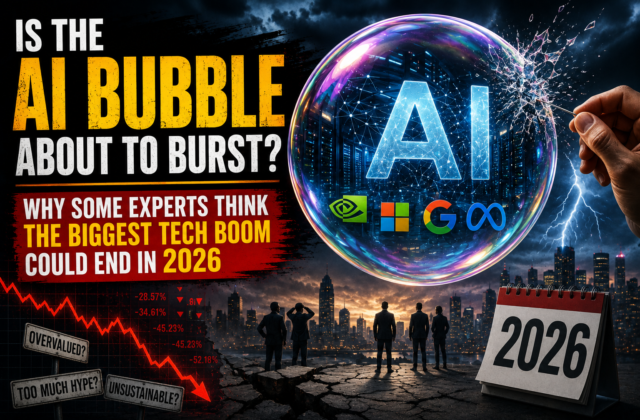
Is the AI Bubble About to Burst? Why Some Experts Think the Biggest Tech Boom Could End in 2026
Is the AI Bubble About to Burst? The Trillion-Dollar Tech Boom Showing Cracks That Investors Can’t Ignore Artificial intelligence has become the defining investment story of the decade. Companies linked to AI have added trillions of dollars in market value, semiconductor demand has surged, and businesses worldwide are racing to integrate AI into their operations....
TheBusinessNow
Jul 21, 2026 · 3 min Read
Key Highlights
- 🚨 AI has become one of the biggest drivers of global equity markets.
- 📈 Technology companies continue investing heavily in AI infrastructure.
- ⚠️ Some analysts believe valuations in parts of the sector may be running ahead of fundamentals.
- 💰 Corporate earnings will play a crucial role in determining whether current expectations are sustainable.
- 🏗️ Data center expansion and semiconductor demand remain central to the AI story.
- 🌍 AI adoption continues across industries, but commercialization and profitability remain under close scrutiny.
- 📊 Investors should distinguish between long-term technological potential and short-term market valuation.
Is the AI Bubble About to Burst? The Trillion-Dollar Tech Boom Showing Cracks That Investors Can’t Ignore
Artificial intelligence has become the defining investment story of the decade.
Companies linked to AI have added trillions of dollars in market value, semiconductor demand has surged, and businesses worldwide are racing to integrate AI into their operations. Investors who backed the trend early have seen extraordinary returns.
Yet alongside the optimism, a growing debate has emerged on Wall Street:
Has excitement around AI moved ahead of economic reality?
Some analysts argue that AI is creating lasting productivity gains that justify today’s valuations. Others warn that parts of the market may be pricing in years of future success before it has fully materialized.
The question is no longer whether AI will transform the economy—it is whether expectations have become too ambitious.
Why AI Became Wall Street’s Biggest Story
Over the past few years, AI has shifted from a specialized technology to a central business strategy.
Major technology companies have committed tens of billions of dollars to:
- AI data centers
- Advanced semiconductor development
- Cloud infrastructure
- Large language models
- Enterprise AI software
- Robotics and automation
This investment wave has helped drive strong gains across parts of the technology sector.
The Numbers Behind the AI Boom
Several trends illustrate the scale of investment:
| Indicator | Trend |
|---|---|
| Global AI investment | Continuing to rise |
| Data center construction | Accelerating |
| Cloud AI spending | Expanding rapidly |
| Semiconductor demand | Near record levels |
| Enterprise AI adoption | Increasing across industries |
Many of the world’s largest technology companies have significantly increased capital expenditure to support AI infrastructure.
Why Some Experts Are Becoming More Cautious
The concern is not that AI lacks potential.
Instead, some market observers question whether current share prices already assume near-perfect execution.
Several factors contribute to this debate:
High Valuations
Some AI-related companies now trade at valuations well above historical averages.
When expectations become very high, even strong earnings can disappoint investors if they fall short of forecasts.
Massive Infrastructure Spending
Building AI systems requires enormous investment in:
- GPUs
- Electricity
- Networking equipment
- Cooling systems
- Data centers
Companies must eventually demonstrate that these investments generate sustainable returns.
Monetization Challenges
Many AI tools have attracted users quickly, but turning widespread adoption into long-term profitability remains an ongoing challenge for parts of the industry.
Lessons From Previous Technology Booms
History shows that transformative technologies can coexist with periods of market excess.
Examples include:
| Technology | Outcome |
|---|---|
| Internet (late 1990s) | Long-term transformation, short-term bubble in many stocks |
| Smartphones | Sustained growth after adoption accelerated |
| Cloud computing | Initially questioned, later became foundational |
| Artificial Intelligence | Still in an early growth phase |
The dot-com era is often cited because many internet companies failed, even though the internet itself fundamentally reshaped the economy.
The same distinction may prove important for AI.
Why This Time Could Be Different
Supporters of AI argue that today’s market differs from earlier bubbles in several ways:
- Many leading AI companies are already profitable.
- AI is being adopted by businesses across industries.
- Cloud providers have established revenue streams.
- Demand for AI computing infrastructure remains strong.
Rather than relying on speculative ideas alone, much of today’s AI investment is backed by existing technology companies with substantial cash flow.
Risks Investors Should Watch
Even if AI continues growing, several risks deserve attention:
Earnings Expectations
Markets will closely watch whether companies can convert AI investment into higher revenue and profits.
Capital Expenditure
Large spending programs increase financial pressure if returns take longer than expected.
Competition
The AI sector is becoming increasingly competitive, with new models and products emerging rapidly.
Regulation
Governments worldwide are considering rules covering AI safety, data use, competition, and intellectual property.
Energy Demand
AI infrastructure requires significant electricity and cooling capacity, making energy costs an important factor.
What Could Trigger a Market Correction?
Several developments could affect investor sentiment:
- Slower-than-expected revenue growth.
- Weaker corporate AI spending.
- Rising interest rates.
- Disappointing quarterly earnings.
- Reduced demand for AI hardware.
A correction, if it occurs, would not necessarily imply that AI itself lacks long-term value.
The Long-Term Outlook
Despite near-term uncertainty, many economists believe AI will remain one of the most influential technologies of the coming decades.
Potential applications include:
- Healthcare
- Manufacturing
- Financial services
- Cybersecurity
- Education
- Logistics
- Scientific research
The pace and profitability of adoption, however, remain key questions for investors.
What Smart Investors Are Watching
Professional investors are paying close attention to:
- Quarterly earnings from major technology companies.
- AI-related capital expenditure plans.
- Data center expansion.
- Semiconductor demand.
- Enterprise software adoption.
- Regulatory developments.
- Interest rate policy.
These indicators may provide clearer evidence of whether AI growth is matching market expectations.
Bubble or Transformation?
The answer may not be binary.
It is possible for AI to become one of the most important technologies in history while certain companies or segments experience periods of overvaluation.
Markets often alternate between optimism and caution before long-term trends become fully established.
Final Verdict
Artificial intelligence is reshaping industries, attracting unprecedented investment, and changing how businesses operate.
Whether current valuations prove justified will depend less on headlines and more on sustained earnings, productivity gains, and successful commercialization.
For investors, the key question is not whether AI has a future—it almost certainly does.
The more difficult question is whether today’s prices already reflect much of that future.
As earnings season, capital spending, and adoption data continue to emerge, markets will gain a clearer picture of whether the AI boom is building a durable foundation or whether expectations have temporarily outpaced reality.
Frequently Asked Questions (FAQs)
What is an AI bubble?
An AI bubble refers to the possibility that some AI-related assets are trading at prices significantly above levels justified by expected future earnings because of unusually optimistic investor expectations.
Is AI expected to disappear if there is a correction?
No. A market correction would not necessarily change AI’s long-term technological importance.
Why are investors discussing an AI bubble?
Rapid increases in valuations, large infrastructure spending, and high growth expectations have led some analysts to question whether parts of the market are becoming overheated.
Which sectors benefit most from AI growth?
Technology, cloud computing, semiconductors, enterprise software, cybersecurity, and automation are among the sectors most directly affected.
What indicators should investors monitor?
Key indicators include corporate earnings, AI adoption rates, capital expenditure, semiconductor demand, regulatory developments, and macroeconomic conditions.
About TheBusinessNow
TheBusinessNow delivers analysis of business, economics, public policy, governance, geopolitics, commodities, and markets. Our reporting focuses on verified information, multiple perspectives, and evidence-based analysis that helps readers understand the forces shaping India and the global economy.
Keep reading
Related Articles
 Crypto
₿ Bitcoin Breaks Above $72,000: Why Trump’s Crypto Push Is Sending Crypto Stocks Higher
Bitcoin’s $72,000 Move Is Bigger Than Bitcoin A typical crypto headline would be: Bitcoin jumps above $72,000. But that misses the most important part of today’s move. The interesting part is the simultaneous rally in: Bitcoin ↓ Coinbase ↓ Strategy ↓ Circle ↓ Robinhood ↓ Bitcoin miners ↓ Crypto infrastructure That tells us investors aren’t...
 News
News
GitHub Down Worldwide: Microsoft-Owned Platform Hit by Major Outage — What Developers and Businesses Need to Know
GitHub Down Today: Global Outage Disrupts Developers, GitHub Actions and Copilot GitHub is experiencing a major service disruption, leaving developers and businesses around the world unable to reliably access some of the platform’s most important services. The Microsoft-owned developer platform began reporting problems on August 17, 2026, with users experiencing errors across GitHub’s website, API,...
 Business
Is Bluesky Down Right Now? Users Report Widespread Outage, Login Problems and Feed Disruptions
Is Bluesky Down Right Now? Users Report Widespread Outage, Login Problems and Feed Disruptions Bluesky users are reporting widespread problems today, August 16, with the social platform failing to load properly for many people across different locations. Reports describe a range of issues, including login failures, blank or blue screens, feeds that refuse to load,...
Comments (0)