
Why Americans Feel Poorer Despite Higher Paychecks: The Hidden Cost of Today’s Economy
Why Americans Feel Poorer Despite Higher Paychecks: The Hidden Cost of Today’s Economy For millions of Americans, payday no longer brings the same sense of financial relief it once did. Paychecks have grown in many industries over the past few years. The labor market has remained relatively resilient, unemployment has stayed historically low, and employers...
TheBusinessNow
Jul 19, 2026 · 2 min Read
Key Highlights
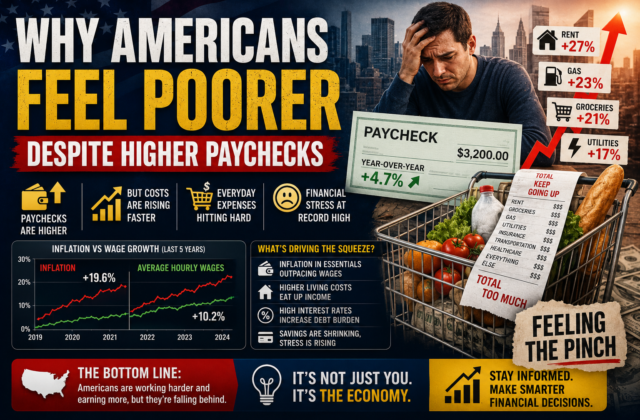
- 💰 Wages have increased across many sectors, but household budgets remain under pressure.
- 🏠 Housing, insurance, healthcare, and childcare continue to absorb a larger share of income.
- 🛒 Many everyday essentials still cost significantly more than they did a few years ago.
- 💳 High interest rates have increased borrowing costs for mortgages, auto loans, and credit cards.
- 📊 Consumers are paying closer attention to savings and discretionary spending.
- 📈 Economists say purchasing power—not just salary—is the better measure of financial well-being.
Why Americans Feel Poorer Despite Higher Paychecks: The Hidden Cost of Today’s Economy
For millions of Americans, payday no longer brings the same sense of financial relief it once did.
Paychecks have grown in many industries over the past few years. The labor market has remained relatively resilient, unemployment has stayed historically low, and employers have increased wages to attract workers. On paper, that sounds like good news.
Yet many households tell a different story.
Despite larger salaries, Americans across income levels continue to report feeling financially stretched. Grocery bills remain elevated, housing costs have climbed, insurance premiums are rising, and debt repayments consume a larger share of monthly budgets. The result is a growing disconnect between income growth and day-to-day purchasing power.
So why do bigger paychecks still feel like they are not enough?
The answer lies in the hidden costs reshaping the American economy.
Bigger Paychecks Don’t Always Mean Greater Wealth
A higher salary does not automatically translate into greater financial security.
If monthly expenses rise at the same pace—or faster—than income, households may still feel financially constrained.
Many families have experienced wage growth while simultaneously facing higher costs for necessities, leaving little room for additional savings or discretionary spending.
The Biggest Expenses Squeezing Household Budgets
| Expense Category | Why It Matters |
|---|---|
| Housing | Rent and homeownership remain major monthly expenses. |
| Groceries | Food prices have increased compared with pre-pandemic levels. |
| Healthcare | Insurance premiums and medical costs continue to weigh on budgets. |
| Transportation | Fuel, maintenance, and vehicle ownership remain costly. |
| Childcare | Families continue to face high childcare expenses in many regions. |
| Insurance | Auto and home insurance premiums have risen in numerous markets. |
These recurring costs often have a greater impact on financial well-being than occasional purchases.
Inflation May Be Cooling, but Prices Remain Higher
Inflation has moderated from its peak in many areas of the economy.
However, moderation does not mean prices have returned to previous levels.
Instead, it generally means prices are rising more slowly than before.
For households, the higher price base remains, making everyday spending feel more expensive than it did several years ago.
Interest Rates Are Changing Household Finances
Higher borrowing costs have affected millions of Americans.
Examples include:
- Mortgage payments on new home purchases.
- Auto loan financing.
- Credit card interest.
- Personal loans.
- Small business borrowing.
For many families, these costs reduce the amount of disposable income available each month.
The Psychology of Feeling Poorer
Financial well-being is influenced by more than income.
Many people compare current spending power with what their paycheck could buy in previous years.
If households feel they must spend more simply to maintain the same lifestyle, they may perceive themselves as financially worse off—even when nominal income has increased.
Where Americans Are Cutting Back
Consumer surveys and spending patterns suggest many households are adjusting their budgets.
| Spending Category | Trend |
|---|---|
| Dining Out | Reduced |
| Travel | More selective |
| Luxury Purchases | Delayed |
| Home Improvements | Slower |
| Streaming & Subscriptions | More cancellations |
| Savings | Prioritized where possible |
Industries Feeling the Impact
Changes in consumer behavior can affect businesses across multiple sectors.
- Retail
- Restaurants
- Travel
- Automotive
- Consumer electronics
- Housing
Companies closely monitor spending trends because they influence revenue growth and hiring decisions.
What Could Improve Consumer Confidence?
Several developments could strengthen household finances over time.
- Slower inflation.
- Stable employment.
- Lower borrowing costs.
- Strong wage growth.
- Increased productivity.
- Improved affordability in housing and essential goods.
Each factor contributes differently depending on household circumstances.
Why This Story Matters
The discussion goes beyond economics.
It affects how families budget, how businesses plan, and how investors evaluate consumer-focused companies.
Understanding the gap between income growth and purchasing power provides important context for the broader US economy.
Final Analysis
The American economy presents a mixed picture.
Higher wages reflect a resilient labor market, but rising living costs and borrowing expenses continue to shape household finances.
For many families, the challenge is not simply earning more—it is preserving purchasing power in an environment where essential expenses consume a larger share of income.
As inflation, interest rates, and consumer behavior evolve, the balance between wage growth and affordability will remain one of the most important economic stories to watch.
FAQs
Why do many Americans feel poorer even with higher pay?
Higher living costs, borrowing expenses, and essential household bills can offset wage gains.
Is inflation still affecting consumers?
Although inflation has moderated in many areas, prices for many goods and services remain higher than they were several years ago.
Which expenses have the biggest impact?
Housing, groceries, healthcare, insurance, transportation, and childcare are among the largest recurring household costs.
Does a higher salary always increase purchasing power?
Not necessarily. Purchasing power depends on how income compares with the cost of living.
Why is this topic important for investors?
Consumer spending is a major driver of the US economy, influencing corporate earnings, retail sales, and broader market performance.
Keep reading
Related Articles
 Finance
Walmart Stock Plunges 6%: What Its Weak Outlook Says About the U.S. Consumer
Walmart Stock Plunges 6% — But the Earnings Were Not Actually Bad This is where the headline can be misleading. Walmart did not report a disastrous quarter. Quite the opposite. Revenue rose 5.9%, operating income increased 28.8%, e-commerce remained extremely strong and Walmart raised its full-year sales and profit expectations. Yet investors immediately sold the...
 Economy
U.S. National Debt Hits $40 Trillion: Why Treasury Yields Are Rising Again
The $40 Trillion Number Is Not the Whole Story The United States has crossed a psychological and financial milestone. $40 trillion. But simply writing “America owes $40 trillion” misses the more important story. The real question for markets is: Who is willing to finance America’s growing debt — and at what interest rate? That question...
 Business
Japan’s Bond Market Is Sending a Warning: 10-Year Yields Near 3% Put the BOJ and Government Under Pressure
Japan’s Bond Market Is Sending a Warning: 10-Year Yields Near 3% Put the BOJ and Government Under Pressure Japan’s once-unthinkably low borrowing costs are disappearing. As the 10-year Japanese government bond yield approaches 3%, investors are reassessing inflation, government spending, the yen and the next move from the Bank of Japan. Japan’s bond market is...
Comments (0)