
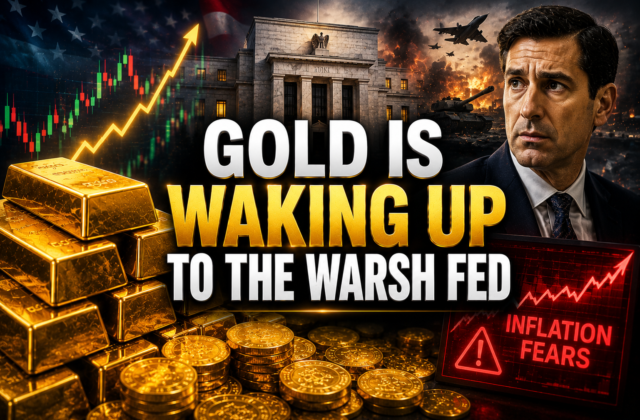
Gold Is Waking Up to the Warsh Fed: Inflation Fears Could Keep Bullion on Edge
Gold Is Waking Up to the Warsh Fed: Inflation Fears Could Keep Bullion on Edge Gold is entering a new phase of the Federal Reserve story. The metal’s next major move may depend less on whether the Fed cuts rates and more on whether investors believe new Fed Chair Kevin Warsh can actually bring inflation...
Brian
Aug 6, 2026 · 3 min Read
Key Highlights
- 🏦 Kevin Warsh is now Federal Reserve chair, having taken office on May 22, 2026.
- 📈 U.S. inflation remains above the Fed's 2% target, increasing pressure on policymakers.
- ⚠️ Fed Governor Lisa Cook recently said she is prepared to support higher rates if inflation fails to ease.
- 🏛️ Minneapolis Fed President Neel Kashkari also backed a rate hike at the latest meeting and emphasized the importance of communicating the Fed's policy reaction function.
- 🔄 Warsh has abandoned the Fed's previous approach to forward guidance, creating greater uncertainty around future policy.
- 🥇 Gold remains highly sensitive to real yields, the dollar, inflation expectations and geopolitical risk.
Gold Is Waking Up to the Warsh Fed: Inflation Fears Could Keep Bullion on Edge
Gold is entering a new phase of the Federal Reserve story.
The metal’s next major move may depend less on whether the Fed cuts rates and more on whether investors believe new Fed Chair Kevin Warsh can actually bring inflation back under control without keeping monetary policy restrictive for too long.
That tension is becoming increasingly important for gold.
Warsh took over as Federal Reserve chair on May 22, 2026, succeeding Jerome Powell. The Fed’s official record confirms that Warsh is serving a four-year term as chair through May 2030.
But markets are now confronting a more complicated policy environment.
Inflation remains above the Fed’s 2% objective, some policymakers are warning that rates may need to rise if price pressures fail to cool, and Warsh has moved away from the Fed’s traditional use of forward guidance.
For gold, that creates a powerful tug-of-war.
Higher real interest rates and a stronger dollar can weigh on bullion.
But persistent inflation, geopolitical uncertainty and doubts about monetary policy can simultaneously strengthen gold’s appeal as a store of value.
That is why the Warsh Fed could become one of the biggest macro drivers for gold through the rest of 2026.
Why Gold Is Suddenly Paying Attention to Kevin Warsh
Gold doesn’t pay interest.
That makes its opportunity cost particularly important.
When Treasury yields and real interest rates rise, investors have a stronger incentive to hold interest-bearing assets rather than an asset that produces no regular income.
When real yields fall, that disadvantage becomes smaller.
This is why expectations surrounding Federal Reserve policy can have an enormous effect on gold.
The Warsh era is particularly interesting because the market is still trying to determine exactly how the new chair intends to balance:
inflation control + economic growth + financial stability.
And right now, inflation is making that equation harder.
Inflation Is the Problem Gold Traders Can’t Ignore
The Federal Reserve’s long-term inflation target is 2%.
But recent Fed commentary shows that policymakers remain concerned about inflation running above that level.
Fed Governor Lisa Cook recently warned that she would be willing to support higher short-term interest rates if inflation does not begin moving lower. She pointed to persistent price and wage pressures as reasons for concern.
That matters for gold because a Fed that is willing to tighten policy can potentially:
- Push Treasury yields higher
- Strengthen the dollar
- Increase real yields
- Reduce demand for non-yielding assets
All three can create headwinds for gold.
But there is another side to the equation.
The Strange Gold Paradox: Inflation Can Hurt and Help Gold
At first glance, inflation should automatically be bullish for gold.
The reality is more complicated.
If inflation rises but the Fed responds aggressively by raising real interest rates, gold can struggle.
If inflation remains high while markets lose confidence that the Fed can bring it down without damaging the economy, gold can become more attractive.
That creates a critical distinction:
Inflation alone isn’t the entire gold story.
The real question is:
What will the Fed do about inflation—and will markets believe it?
That is where Warsh becomes important.
The Warsh Fed Is Changing How It Talks to Markets
One of the most significant changes under Warsh is the Fed’s approach to forward guidance.
Reuters reported that Warsh has rejected the previous approach to forward guidance, while the Fed has launched task forces to review its policy strategy and communications.
That could have important consequences for financial markets.
For years, investors have closely watched Fed statements for clues about where interest rates could go next.
Now, if the central bank provides less explicit guidance, markets may have to rely more heavily on:
- Inflation data
- Employment data
- Treasury yields
- Financial conditions
- Fed speeches
- Economic forecasts
- Incoming geopolitical developments
That potentially means larger reactions to individual economic reports.
And gold could become one of the assets most sensitive to those shifts.
Why the Dollar Matters So Much for Gold
Gold is primarily priced in U.S. dollars.
That means changes in the dollar can significantly affect the metal’s international price.
A stronger dollar generally makes gold more expensive for buyers using other currencies.
A weaker dollar can have the opposite effect.
The Federal Reserve sits at the center of that equation because interest-rate expectations influence capital flows into and out of dollar-denominated assets.
If markets conclude that Warsh will keep monetary policy tighter for longer, the dollar could receive support.
That could put pressure on gold.
But if inflation remains stubborn while economic growth deteriorates, the market could eventually begin pricing future easing.
That would create a very different environment.
Gold Has Already Shown How Violently Sentiment Can Change
The World Gold Council’s 2026 mid-year outlook provides an important reminder of how volatile the metal has become.
According to the council, gold surged above $5,500 per ounce intraday in January before falling below $4,000 in late June. Despite the decline, it remained one of the stronger-performing major assets over the preceding year.
That is an enormous range.
It demonstrates that gold is no longer simply responding to one variable.
Investors are simultaneously watching:
- Central-bank policy
- Inflation
- Geopolitical tensions
- Dollar movements
- Sovereign debt
- Central-bank gold purchases
- Investor positioning
- Asian demand
The Warsh Fed therefore becomes one piece of a much larger market puzzle.
The Fed Is Not Speaking With One Voice
Another reason gold traders should be cautious is the growing difference in views among Fed officials.
Kashkari recently argued that inflation remains too high and supported a rate increase at the latest meeting.
Cook has separately indicated that she could support higher rates if inflation does not improve.
That suggests the market cannot simply assume that the next policy move will automatically be a rate cut.
Instead, the Fed’s reaction function is becoming increasingly important.
If inflation continues to surprise on the upside, expectations for easing could weaken.
If employment deteriorates sharply while inflation falls, the opposite could happen.
Gold will respond to that changing probability distribution.
🔥 The Biggest Question: Can Warsh Beat Inflation?
This is the central issue behind the renewed focus on gold.
If Warsh succeeds in bringing inflation back toward 2% without causing a severe economic downturn, the market could eventually see:
lower inflation → lower inflation risk → potentially lower long-term yields → more predictable monetary policy.
That could produce mixed effects for gold.
But if inflation proves stubborn and the Fed has to maintain restrictive policy for longer, gold could initially face pressure from higher real yields.
The more dangerous scenario for policymakers would be if inflation stays elevated while growth weakens.
That is the environment often described as stagflationary pressure.
For gold, such an environment can become considerably more supportive because investors begin looking for assets that can preserve purchasing power during periods of economic uncertainty.
Gold vs. Higher Interest Rates
The traditional relationship is straightforward.
Higher rates → potentially bearish for gold
Investors can earn more from bonds and cash-like instruments, increasing the opportunity cost of owning gold.
Lower rates → potentially bullish for gold
The opportunity cost of holding gold decreases.
But modern gold markets are more complicated.
Central-bank buying, geopolitical risk and concerns about fiscal sustainability can support gold even when rates are relatively high.
That’s one reason investors shouldn’t treat the Fed funds rate as a standalone gold-price indicator.
Could the Warsh Fed Actually Be Bullish for Gold?
Yes—but probably not for the obvious reason.
If Warsh succeeds in restoring confidence in the Fed’s inflation-fighting credibility, gold could initially face pressure.
But if the market begins to believe that the Fed has limited room to maneuver because of economic weakness, government debt or geopolitical shocks, the interpretation could change.
Gold’s appeal isn’t simply:
“The Fed will cut rates.”
It can also be:
“The economic and monetary environment is becoming harder to predict.”
That distinction matters.
What Investors Should Watch Next
For gold traders, several indicators deserve particular attention.
1. Core Inflation
If inflation remains sticky, markets may push back expectations for aggressive easing.
That would potentially pressure gold.
2. Treasury Real Yields
Real yields remain one of the most important macro variables for bullion.
A sustained rise could create a headwind.
3. U.S. Dollar
A strong dollar can make gold less attractive internationally.
A weakening dollar can provide support.
4. Fed Communications
Under Warsh, speeches and policy documents could become even more important because the central bank is reducing reliance on traditional forward guidance.
5. Employment
If the labor market weakens substantially, the Fed may face greater pressure to balance its inflation fight against employment risks.
6. Geopolitical Risk
Gold can attract safe-haven demand during periods of severe geopolitical uncertainty.
📊 Gold Outlook: Bullish or Bearish From Here?
The answer isn’t one-directional.
🟢 Bullish Scenario
Gold could strengthen if:
- Inflation remains elevated
- Real yields fall
- The dollar weakens
- Geopolitical risks intensify
- Investors expect future Fed easing
- Central-bank demand remains strong
🔴 Bearish Scenario
Gold could face pressure if:
- Inflation falls faster than expected
- Warsh maintains a restrictive stance
- Real yields rise
- The dollar strengthens
- Investors move aggressively into bonds and equities
🟡 Mixed Scenario
The most complicated possibility is:
inflation remains high + economic growth slows + the Fed stays restrictive.
That could create substantial short-term volatility while keeping longer-term demand for gold alive.
🔮 Gold Price Outlook: What Comes Next?
The biggest mistake investors could make now is assuming that Warsh automatically means bearish gold.
The relationship is much more complicated.
A determined inflation-fighting Fed can push gold lower through higher real yields.
But persistent inflation can simultaneously reinforce gold’s role as a hedge.
The critical variable will be credibility.
If markets believe Warsh can control inflation while maintaining economic stability, the dollar and real yields could become more important than inflation fears.
If markets instead begin to question whether monetary policy can control prices without causing significant economic damage, gold could regain momentum.
The World Gold Council’s mid-year assessment similarly highlighted the metal’s sensitivity to changing macroeconomic conditions and geopolitical risks, while noting that the market remained positioned for the possibility of another breakout.
💰 What This Means for Gold Investors
Gold investors should watch the direction of real yields, rather than simply reacting to headlines about Fed rate cuts.
A headline saying “Fed may cut rates” is not automatically bullish.
If inflation is simultaneously rising, bond yields can remain elevated.
Likewise, a headline saying “Fed may keep rates higher” isn’t automatically disastrous for gold if geopolitical risk or currency concerns create strong safe-haven demand.
The better question is:
Are real returns on safe assets rising or falling relative to inflation and risk?
That is where the Fed’s next moves could have the greatest influence.
Final Thoughts
Gold is entering a new chapter with Kevin Warsh at the Federal Reserve.
The immediate challenge isn’t simply whether the Fed will cut or raise rates.
It is whether markets believe the new Fed leadership can successfully control inflation while navigating a potentially complicated growth and geopolitical environment.
Warsh has already changed the central bank’s communication strategy, while other Fed officials are openly warning that rates could need to rise if inflation remains too high.
For gold, that creates a delicate balance.
Higher real yields could cap the upside.
Persistent inflation and uncertainty could revive demand.
And if the market begins to question whether monetary policy can simultaneously defeat inflation and protect growth, gold could once again become the asset investors turn to for protection.
The next major gold move may therefore depend less on a single Fed meeting and more on one question:
Can the Warsh Fed convince markets that inflation is finally under control?
❓ FAQs
Why is the Warsh Fed important for gold?
Federal Reserve policy affects interest rates, real yields, the dollar and inflation expectations—all major drivers of gold prices.
Is Kevin Warsh bullish or bearish for gold?
There is no simple answer. A more restrictive Fed could pressure gold through higher real yields, while persistent inflation or economic uncertainty could support demand for bullion.
Why does inflation affect gold?
Gold is often used as a store of value during periods of currency and purchasing-power uncertainty. However, the impact depends heavily on how aggressively the Fed responds to inflation.
What happens to gold when real yields rise?
Higher real yields generally increase the opportunity cost of holding gold and can create downward pressure on the metal.
Could higher inflation actually push gold higher?
Yes. If inflation remains elevated and investors become concerned about purchasing-power erosion or the Fed’s ability to control prices, gold can attract additional demand.
What should gold investors watch now?
Watch U.S. inflation data, Treasury real yields, the dollar, employment data, Fed communications and geopolitical developments.
Who is Kevin Warsh?
Kevin Warsh became Federal Reserve chair on May 22, 2026. He previously served as a Federal Reserve governor from 2006 to 2011.
🌐 External Resources
Keep reading
Related Articles
 Commodities
Oil Nears $95: Could the Iran War Trigger a New U.S. Inflation Shock?
Oil at $95 Is Not the Real Story A crude-oil headline is easy to write: “Oil prices rise as Iran tensions escalate.” Reuters, Bloomberg, CNBC and WSJ can publish that story within minutes. But for TheBusinessNow, that isn’t enough. The bigger question is: What happens to the American economy if oil stays near $95 —...
 Commodities
Strait of Hormuz Standoff: The Oil Shock That Could Hit the U.S. Economy Next
Strait of Hormuz Standoff: Why the Oil Market Is Getting Nervous Again The oil market is being forced to price a problem that seemed to be easing only weeks ago: the Strait of Hormuz is still not reliably functioning as a normal commercial shipping route. On August 19, Brent crude was trading around $91.20 a...
 Commodities
China’s “Ice Silk Road” After Hormuz: The Arctic Shipping Route That Could Reshape Global Trade
China’s “Ice Silk Road” Is Moving From Vision to Reality For decades, the idea of using the Arctic Ocean as a major commercial highway between Asia and Europe seemed more like a geopolitical thought experiment than a realistic alternative to the Suez Canal. That is beginning to change. China is increasingly looking toward the Northern...
Comments (0)