
Trump Warns Iran After Red Sea Tanker Attacks: Could the World’s Most Critical Shipping Route Be at Risk?
Trump Warns Iran After Red Sea Tanker Attacks: Could the World’s Most Critical Shipping Route Be at Risk? A fresh escalation in the Middle East has once again placed one of the world’s most important maritime trade routes under intense global scrutiny. After two Saudi oil tankers were attacked in the Red Sea, U.S. President...
TheBusinessNow
Jul 23, 2026 · 2 min Read
Key Highlights
- 🚨 President Donald Trump said the U.S. would hold Iran responsible for future Houthi attacks following attacks on Saudi oil tankers in the Red Sea.
- 🚢 The Red Sea is one of the world's most critical maritime trade routes, linking Europe, Asia, and the Middle East through the Suez Canal.
- 🛢️ The latest escalation has renewed concerns over global oil supplies, shipping security, and energy market volatility.
- 📈 Investors are closely monitoring the situation as higher shipping costs and geopolitical tensions could influence inflation and financial markets.
- 🌍 Any prolonged disruption in the Red Sea could affect global supply chains, freight rates, insurance costs, and international trade.
- 🏦 Energy prices remain a key factor influencing central bank decisions, inflation expectations, and global economic growth.
Trump Warns Iran After Red Sea Tanker Attacks: Could the World’s Most Critical Shipping Route Be at Risk?
A fresh escalation in the Middle East has once again placed one of the world’s most important maritime trade routes under intense global scrutiny.
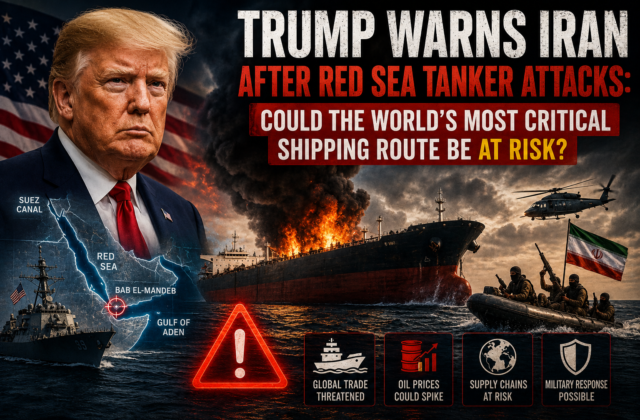
After two Saudi oil tankers were attacked in the Red Sea, U.S. President Donald Trump declared that the United States would hold Iran responsible for any future attacks carried out by Yemen’s Houthi movement, describing the Houthis as an Iranian proxy. His warning came as fears grew that the conflict could spread beyond military targets and further disrupt global energy flows.
The development has immediately caught the attention of governments, investors, shipping companies, and energy markets because the Red Sea is not just another waterway—it is one of the world’s most strategically important trade corridors.
What Happened?
According to multiple reports, Houthi forces claimed responsibility for attacks on two Saudi oil tankers in the Red Sea using missiles and drones. The incident follows earlier Houthi threats to impose a maritime blockade on Saudi-linked vessels and comes amid continuing regional tensions involving Iran and the United States.
In response, President Trump posted that if similar attacks continue, Iran would be held responsible and warned of “major military punishment” against both Iran and the Houthis.
Why the Red Sea Matters
The Red Sea connects the Bab el-Mandeb Strait with the Suez Canal, creating one of the world’s busiest shipping corridors.
Every year this route carries:
- Crude oil
- Refined petroleum products
- LNG shipments
- Consumer goods
- Industrial equipment
- Container cargo between Asia and Europe
Any prolonged disruption forces vessels to take much longer routes around southern Africa, increasing transit time, fuel consumption, insurance costs, and freight charges.
Why Markets React Immediately
Energy markets are highly sensitive to geopolitical risk.
Even before any confirmed supply interruption occurs, traders often price in the possibility of future disruptions.
Following renewed tensions, oil prices remained elevated, with Brent crude trading around the psychologically important $100 per barrel level amid concerns over regional supply security.
Why Iran Is at the Center of the Dispute
The United States has long accused Iran of supporting the Houthis through weapons, funding, and training. Iran has repeatedly rejected accusations that it directs every Houthi military operation.
Trump’s latest statement reflects Washington’s position that future Houthi attacks could trigger broader consequences for Tehran.
Could Global Shipping Be Affected?
Shipping companies closely monitor security in the Red Sea because uncertainty alone can increase costs.
Potential consequences include:
- Higher marine insurance premiums
- Shipping delays
- Vessel rerouting
- Increased freight rates
- Higher fuel transportation costs
If disruptions persist, businesses dependent on international supply chains could experience additional cost pressures.
What It Means for Oil Prices
The Red Sea serves as a vital route for energy exports.
If attacks continue or shipping volumes decline, markets may anticipate tighter supplies.
Historically, geopolitical risks affecting major shipping routes have contributed to increased oil price volatility, although prices also depend on production levels, global demand, and inventory data.
Could Inflation Feel the Impact?
Energy prices influence nearly every part of the economy.
If shipping costs and crude prices remain elevated, businesses may face higher expenses for:
- Transportation
- Manufacturing
- Food distribution
- Aviation
- Retail logistics
Whether those higher costs translate into sustained inflation will depend on how long disruptions last and how companies absorb or pass on the additional expenses.
Investors Are Watching More Than Oil
Financial markets are assessing several risks simultaneously:
- Oil price volatility
- Shipping disruptions
- Defense sector developments
- Airline costs
- Inflation expectations
- Central bank policy
Periods of geopolitical uncertainty often increase demand for traditionally defensive assets, though market reactions can change rapidly as new information emerges.
Could This Affect Global Trade?
The Red Sea is one of the key links between Europe, Asia, and the Middle East.
If security conditions deteriorate significantly, global trade could experience:
- Longer delivery times
- Increased logistics expenses
- Supply chain bottlenecks
- Pressure on import-dependent industries
Businesses that rely on just-in-time delivery systems may be especially sensitive to prolonged disruptions.
Diplomatic Challenges Ahead
Alongside military developments, governments continue diplomatic efforts aimed at preventing a wider regional conflict.
The coming weeks may depend on:
- Whether additional tanker attacks occur
- Responses from regional governments
- International naval security measures
- Diplomatic negotiations
- Future statements from Washington and Tehran
Each development could influence both geopolitical stability and financial markets.
What Happens Next?
Several scenarios remain possible:
Scenario 1: Tensions Ease
If attacks stop and diplomatic efforts succeed, shipping confidence could improve and market volatility may decline.
Scenario 2: Continued Maritime Attacks
Repeated incidents could keep insurance costs elevated and maintain upward pressure on oil prices.
Scenario 3: Wider Regional Escalation
Any broader confrontation involving major regional powers could have more significant implications for global energy markets and international trade. The likelihood of such an outcome remains uncertain and depends on future political and military decisions.
Final Analysis
President Trump’s warning that the United States would hold Iran responsible for future Houthi attacks has added a new layer of uncertainty to an already volatile Middle East. Combined with the reported attacks on Saudi oil tankers, the latest developments have renewed attention on the Red Sea—a maritime corridor that underpins global commerce and energy transport.
For investors, businesses, and governments, the immediate concern is not only the security situation but also the broader economic implications. Higher shipping costs, elevated oil prices, and supply-chain disruptions could ripple through global markets if tensions continue.
Whether the crisis escalates or stabilizes will depend on developments in the coming days. For now, the Red Sea has once again become one of the world’s most closely watched geopolitical flashpoints, with consequences that could extend far beyond the Middle East.
❓ Frequently Asked Questions (FAQs)
1. What did President Trump say about Iran?
President Trump stated that the United States would hold Iran responsible for future Houthi attacks following the reported attacks on Saudi oil tankers in the Red Sea.
2. Why is the Red Sea strategically important?
The Red Sea connects the Bab el-Mandeb Strait to the Suez Canal, making it one of the world’s busiest shipping corridors for oil, liquefied natural gas (LNG), container cargo, and international trade.
3. How could these attacks affect global oil prices?
If shipping disruptions continue or energy supplies are threatened, oil prices could become more volatile as markets react to increased geopolitical risk.
4. Could this impact inflation?
Potentially. Higher oil prices and increased shipping costs can raise transportation and manufacturing expenses, which may contribute to inflation if sustained over time.
5. Why are financial markets paying close attention?
Geopolitical tensions in major energy-producing regions can influence commodity prices, investor sentiment, shipping costs, and broader economic expectations.
6. Could global trade be disrupted?
If security risks in the Red Sea increase significantly, some shipping companies may reroute vessels, increasing delivery times and transportation costs for international trade.
7. What should investors monitor next?
Key developments include any additional maritime incidents, official statements from the U.S., Iran, Saudi Arabia, and international organizations, as well as movements in oil prices and shipping markets.
🌐 About The Business Now
The Business Now is a global business, finance, and geopolitics publication delivering fact-based reporting, market intelligence, and in-depth analysis on world events that shape economies and financial markets.
Our coverage includes:
- 📈 Global Markets & Investing
- 🛢️ Energy & Commodities
- 🌍 Geopolitics & International Affairs
- 🤖 AI & Technology
- 💼 Business & Corporate News
- 💰 Personal Finance & Economic Trends
The Business Now — Explaining the World’s Biggest Stories Through the Lens of Business and Markets.
Keep reading
Related Articles
 Crypto
₿ Bitcoin Breaks Above $72,000: Why Trump’s Crypto Push Is Sending Crypto Stocks Higher
Bitcoin’s $72,000 Move Is Bigger Than Bitcoin A typical crypto headline would be: Bitcoin jumps above $72,000. But that misses the most important part of today’s move. The interesting part is the simultaneous rally in: Bitcoin ↓ Coinbase ↓ Strategy ↓ Circle ↓ Robinhood ↓ Bitcoin miners ↓ Crypto infrastructure That tells us investors aren’t...
 Markets
U.S. Treasury Doubles Bond Buybacks: Why Markets Are Still Worried About Rising Yields
The Treasury Just Sent Two Messages to Wall Street At first glance, this looks like a straightforward market-support operation. Treasury says: We want to improve liquidity in longer-dated Treasury securities. Investors hear: Washington is increasingly concerned about the rise in long-term borrowing costs. And that second interpretation is what makes this story important. The Treasury...
 Commodities
Oil Nears $95: Could the Iran War Trigger a New U.S. Inflation Shock?
Oil at $95 Is Not the Real Story A crude-oil headline is easy to write: “Oil prices rise as Iran tensions escalate.” Reuters, Bloomberg, CNBC and WSJ can publish that story within minutes. But for TheBusinessNow, that isn’t enough. The bigger question is: What happens to the American economy if oil stays near $95 —...
Comments (0)