
Super El Niño Warning: Could the Next Climate Shift Disrupt Food Prices, Energy Markets, and the Global Economy?
Super El Niño Warning: Could the Next Climate Shift Disrupt Food Prices, Energy Markets, and the Global Economy? Weather rarely makes financial headlines—until it starts moving markets. New long-range forecasts from meteorological researchers are drawing attention to the possibility of a very strong El Niño event developing into late 2026 and early 2027. While no...
TheBusinessNow
Jul 23, 2026 · 3 min Read
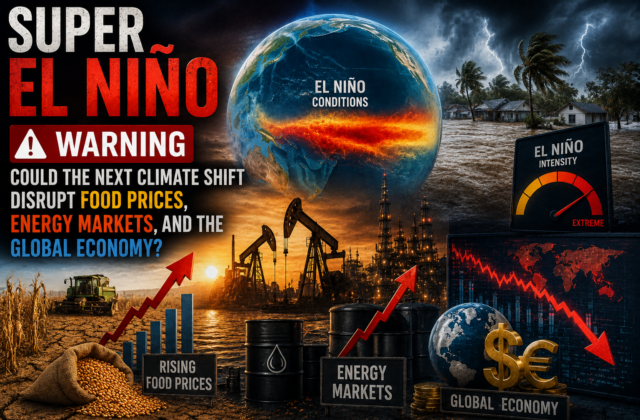
Key Highlights
- 🌊 Scientists are closely monitoring forecasts that suggest a potentially strong El Niño could develop during late 2026 into 2027.
- 🌍 A stronger El Niño could influence global weather patterns, agriculture, food production, and energy demand.
- 🌾 Weather disruptions may increase volatility in food prices, especially for crops like rice, wheat, coffee, cocoa, and corn.
- ⚡ Energy markets could also be affected through changes in electricity demand, hydropower output, and natural gas consumption.
- 📈 If food and energy prices rise together, inflation could remain under pressure, influencing central bank decisions worldwide.
- 🚢 Governments, businesses, and investors are monitoring climate forecasts because extreme weather can disrupt supply chains and economic activity.
Super El Niño Warning: Could the Next Climate Shift Disrupt Food Prices, Energy Markets, and the Global Economy?
Weather rarely makes financial headlines—until it starts moving markets.
New long-range forecasts from meteorological researchers are drawing attention to the possibility of a very strong El Niño event developing into late 2026 and early 2027. While no outcome is guaranteed and forecasts months in advance carry uncertainty, scientists are increasingly monitoring signals that could point toward one of the more significant El Niño episodes in recent years.
If such an event develops, the consequences may extend well beyond rainfall and temperatures. A powerful El Niño has the potential to influence agriculture, energy demand, commodity prices, insurance losses, shipping, and inflation, making it an issue watched not only by climate scientists but also by investors, governments, and businesses.
What Is El Niño?
El Niño is a naturally occurring climate pattern caused by unusually warm sea surface temperatures across the central and eastern tropical Pacific Ocean.
This warming changes atmospheric circulation and can alter weather patterns around the world.
Typical impacts include:
- Increased rainfall in some regions
- Drought in others
- Changes in hurricane activity
- Marine ecosystem disruptions
- Shifts in agricultural productivity
A “Super El Niño” generally refers to an exceptionally strong El Niño event, although there is no single universally accepted definition.
Why Scientists Are Watching 2026–2027
Recent forecast models highlighted by weather researchers indicate that ocean and atmospheric conditions could become increasingly favorable for a stronger El Niño later in 2026.
Forecast confidence naturally decreases the further ahead scientists look, and conditions can still evolve differently. However, the emerging signals are strong enough to attract attention from climate agencies and long-range forecasting groups.
Meteorologists will continue monitoring:
- Pacific Ocean temperatures
- Trade wind strength
- Ocean heat content
- Atmospheric circulation patterns
Why This Matters Beyond the Weather
A strong El Niño does more than change the forecast.
It can influence the global economy in several ways.
1. Food Prices Could Face New Pressure
Agriculture is one of the first sectors affected by changing rainfall patterns.
Potential impacts include:
- Lower crop yields in drought-prone areas
- Flood damage in agricultural regions
- Higher irrigation costs
- Reduced harvest quality
- Volatility in global food exports
Key commodities that may experience price swings include:
- Rice
- Wheat
- Corn
- Soybeans
- Coffee
- Cocoa
- Sugar
Even moderate disruptions in major producing countries can affect international food prices.
2. Energy Markets May Become More Volatile
Weather influences energy demand and supply.
Depending on the region, a strong El Niño can affect:
- Hydropower generation
- Natural gas demand
- Electricity consumption
- Cooling requirements
- Renewable energy output
Utilities and energy traders closely monitor seasonal weather because unexpected changes can shift demand significantly.
3. Inflation Risks Could Return
Food and energy are major components of inflation.
If weather-related disruptions increase prices in both sectors simultaneously, central banks may find it more difficult to keep inflation under control.
This could influence:
- Interest rate expectations
- Consumer spending
- Business costs
- Investment decisions
4. Insurance Costs Could Rise
Extreme weather events often lead to higher insurance claims.
Floods, storms, droughts, and wildfires can increase losses for insurers, which may eventually affect premiums for businesses and homeowners.
5. Global Supply Chains Could Face New Challenges
Modern supply chains depend on predictable weather.
A powerful El Niño could affect:
- Agricultural exports
- Shipping routes
- Inland transportation
- Manufacturing inputs
- Port operations
Companies with diversified supply networks are generally better positioned to manage weather-related disruptions.
Which Regions Could Be Most Affected?
While impacts vary with every El Niño event, historical patterns suggest heightened attention for:
- Parts of South America
- Australia
- Southeast Asia
- North America
- Southern Africa
Some regions may experience increased rainfall, while others could face prolonged dry conditions.
Local outcomes depend on many additional climate factors.
Lessons From Previous Strong El Niño Events
Past strong El Niño episodes have been associated with:
- Significant agricultural disruptions
- Increased weather-related disasters
- Changes in global commodity prices
- Pressure on food security in vulnerable regions
However, every El Niño is unique. No two events produce exactly the same outcomes.
What Investors Are Watching
Financial markets increasingly incorporate climate risks into investment decisions.
A stronger El Niño could influence sectors such as:
Potential beneficiaries
- Agricultural technology
- Water management
- Weather analytics
- Irrigation equipment
- Certain utility providers
Potentially vulnerable sectors
- Agriculture
- Food processing
- Insurance
- Transportation
- Energy-intensive industries
Commodity markets may also experience greater price volatility.
Governments Are Preparing Earlier
Many governments now use advanced forecasting systems to prepare for climate-related risks.
Preparation may include:
- Water conservation planning
- Crop advisories
- Emergency response coordination
- Infrastructure protection
- Disaster risk management
Early preparation often reduces the long-term economic impact of extreme weather.
What Happens Next?
Scientists will continue evaluating new data over the coming months.
Important indicators include:
- Pacific Ocean temperature anomalies
- Atmospheric pressure changes
- Wind patterns
- International climate model updates
As confidence improves, forecasts will become more precise.
Final Analysis
The possibility of a strong El Niño developing in late 2026 or early 2027 is attracting global attention because climate events increasingly shape economic outcomes.
While forecasts remain subject to change and it is too early to predict exact impacts, history shows that major El Niño episodes can influence food prices, energy markets, inflation, supply chains, insurance costs, and economic growth across multiple continents.
For businesses, investors, policymakers, and households, the coming months will be important as scientists refine their forecasts. Whether the event ultimately reaches “super” intensity or not, monitoring climate developments has become just as important as tracking interest rates, oil prices, and economic data.
In today’s interconnected world, the next major market-moving event may begin not in a stock exchange or central bank—but in the waters of the Pacific Ocean.
❓ Frequently Asked Questions (FAQs)
1. What is a Super El Niño?
A Super El Niño refers to an exceptionally strong El Niño event characterized by unusually warm sea surface temperatures in the central and eastern Pacific Ocean, which can significantly alter global weather patterns.
2. Is a Super El Niño confirmed for 2026–2027?
No. Current long-range forecasts indicate that conditions may become favorable for a strong El Niño, but scientists emphasize that forecasts months in advance remain uncertain and will continue to be updated.
3. How could El Niño affect food prices?
Changes in rainfall and temperature can impact crop production in different regions, potentially affecting global supplies of grains, coffee, cocoa, sugar, and other agricultural commodities.
4. Why are investors paying attention to El Niño?
Climate events can influence agricultural output, energy demand, commodity prices, insurance claims, transportation, and inflation—all of which affect financial markets and business performance.
5. Can El Niño increase inflation?
It can contribute to inflation if weather-related disruptions raise food and energy prices. However, inflation also depends on monetary policy, demand, and broader economic conditions.
6. Which regions are usually affected by El Niño?
Historical El Niño events have influenced weather across South America, North America, Australia, Southeast Asia, and parts of Africa, although impacts vary with each event.
7. What should people watch over the coming months?
Updates from meteorological agencies, Pacific Ocean temperature trends, seasonal climate forecasts, and reports from organizations such as NOAA and the World Meteorological Organization (WMO) will provide a clearer picture.
🌐 About The Business Now
The Business Now is an independent business and global affairs publication delivering fact-based reporting and in-depth analysis on finance, markets, geopolitics, technology, energy, AI, climate, and the global economy.
We explain what happened, why it matters, and how it could affect investors, businesses, policymakers, and everyday readers through data-driven journalism and expert analysis.
Stay Ahead. Stay Informed. Stay with The Business Now.
Keep reading
Related Articles
 Crypto
₿ Bitcoin Breaks Above $72,000: Why Trump’s Crypto Push Is Sending Crypto Stocks Higher
Bitcoin’s $72,000 Move Is Bigger Than Bitcoin A typical crypto headline would be: Bitcoin jumps above $72,000. But that misses the most important part of today’s move. The interesting part is the simultaneous rally in: Bitcoin ↓ Coinbase ↓ Strategy ↓ Circle ↓ Robinhood ↓ Bitcoin miners ↓ Crypto infrastructure That tells us investors aren’t...
 Markets
U.S. Treasury Doubles Bond Buybacks: Why Markets Are Still Worried About Rising Yields
The Treasury Just Sent Two Messages to Wall Street At first glance, this looks like a straightforward market-support operation. Treasury says: We want to improve liquidity in longer-dated Treasury securities. Investors hear: Washington is increasingly concerned about the rise in long-term borrowing costs. And that second interpretation is what makes this story important. The Treasury...
 Commodities
Oil Nears $95: Could the Iran War Trigger a New U.S. Inflation Shock?
Oil at $95 Is Not the Real Story A crude-oil headline is easy to write: “Oil prices rise as Iran tensions escalate.” Reuters, Bloomberg, CNBC and WSJ can publish that story within minutes. But for TheBusinessNow, that isn’t enough. The bigger question is: What happens to the American economy if oil stays near $95 —...
Comments (0)