
He Didn’t Build Rockets for Elon Musk—He Built Them for India’s Space Future
He Didn’t Build Rockets for Elon Musk—He Built Them for India’s Space Future Success stories often begin with a bold vision. But sometimes, they begin with a surprisingly modest paycheck. When Pawan Kumar Chandana graduated from IIT Kharagpur, he had the credentials to pursue high-paying opportunities in the private sector. Instead, he chose a different...
TheBusinessNow
Jul 23, 2026 · 3 min Read
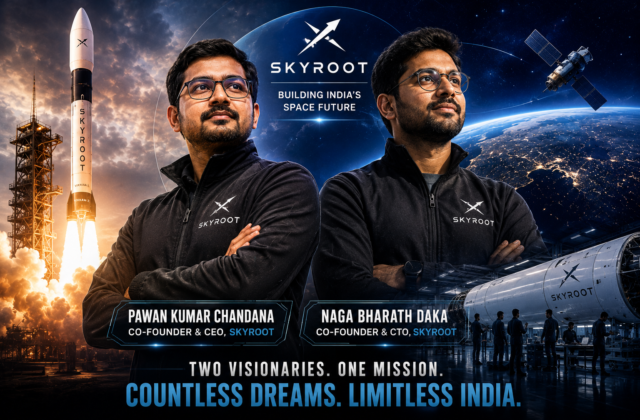
Key Highlights
- 🇮🇳 Pawan Kumar Chandana chose ISRO over a higher-paying private-sector job, prioritizing learning and hands-on space engineering experience over immediate financial rewards.
- 💰 Starting with a salary of around ₹40,000 per month, he gained expertise in rocket propulsion, launch systems, and mission engineering that later became the foundation of his entrepreneurial journey.
- 🛰️ After leaving ISRO, Chandana co-founded Skyroot Aerospace, one of India's pioneering private space companies, helping accelerate the country's commercial space ecosystem.
- 🚀 Skyroot made history with the successful launch of Vikram-S, India's first privately developed rocket to reach space, marking a major milestone for Indian private spaceflight.
- 🦄 Skyroot later became India's first private space unicorn, reflecting growing investor confidence in the country's rapidly expanding space economy.
- 🌍 India's space sector is undergoing a transformation, with policy reforms enabling private companies to work alongside ISRO in satellite launches, launch vehicles, and space technology.
He Didn’t Build Rockets for Elon Musk—He Built Them for India’s Space Future
Success stories often begin with a bold vision. But sometimes, they begin with a surprisingly modest paycheck.
When Pawan Kumar Chandana graduated from IIT Kharagpur, he had the credentials to pursue high-paying opportunities in the private sector. Instead, he chose a different path—joining the Indian Space Research Organisation (ISRO) with a monthly salary of around ₹40,000.
For many, that decision may have seemed financially unremarkable.
In hindsight, it became one of the most important career decisions in India’s emerging private space industry.
Years later, Chandana would co-found Skyroot Aerospace, the first Indian private space startup to achieve unicorn status, helping redefine what was possible for India’s commercial space ecosystem.
His journey is a reminder that the most valuable investment in a career isn’t always the first salary—it’s often the experience that enables you to build something transformative.
The Decision That Changed Everything
Fresh out of IIT Kharagpur, Chandana had options.
Many graduates from India’s premier engineering institutions pursue lucrative careers in multinational companies or overseas technology firms.
Instead, he chose ISRO.
The salary was modest compared with many private-sector offers, but the opportunity was exceptional.
At ISRO, Chandana gained hands-on experience in:
- Rocket propulsion
- Launch vehicle engineering
- Mission planning
- Systems integration
- Space technology development
These experiences would later become the technical foundation for his entrepreneurial journey.
Why ISRO Became the Perfect Classroom
ISRO has long been recognized as one of the world’s most respected space agencies.
Its achievements include:
- Mars Orbiter Mission (Mangalyaan)
- Chandrayaan lunar missions
- PSLV launch vehicle successes
- Cost-effective satellite launches
- Deep-space exploration
Working in such an environment offered Chandana exposure that few private companies in India could match at the time.
More importantly, it taught him how complex space missions are designed, tested, and executed under demanding conditions.
From Engineer to Entrepreneur
After several years at ISRO, Chandana and his co-founder Naga Bharath Daka, also a former ISRO engineer, recognized a major opportunity.
Around the world, the commercial space industry was evolving rapidly.
Private companies were beginning to launch satellites, develop reusable rockets, and serve a growing market for space-based services.
India, however, had very few private players in launch technology.
That gap inspired the creation of Skyroot Aerospace in 2018.
Building a Private Space Company Was Never Easy
Launching a startup is difficult.
Launching a rocket company is exponentially harder.
Skyroot had to overcome challenges such as:
- Raising capital
- Building highly specialized engineering teams
- Designing launch vehicles
- Developing propulsion systems
- Navigating regulatory frameworks
- Winning investor confidence
Unlike software startups, aerospace companies require years of research, testing, and certification before generating significant revenue.
A Historic Milestone
Skyroot made history in November 2022 with the successful launch of Vikram-S, India’s first privately developed rocket to reach space.
The mission demonstrated that private Indian companies could design, manufacture, and launch rockets independently.
It marked a turning point for India’s commercial space ambitions.
India’s Space Economy Is Changing
For decades, India’s space program was led almost entirely by ISRO.
Recent policy reforms have encouraged greater participation by private companies through organizations such as IN-SPACe, creating opportunities for startups to innovate alongside the national space agency.
This has opened the door for companies working in:
- Satellite manufacturing
- Launch services
- Space-based communications
- Earth observation
- Deep-space technologies
Skyroot has become one of the most prominent examples of this transformation.
Becoming India’s First Space Unicorn
Skyroot later achieved unicorn status, becoming the first Indian space startup valued at more than $1 billion.
That milestone reflected growing investor confidence in India’s expanding commercial space sector.
It also highlighted a broader trend: space is no longer viewed solely as a government activity but increasingly as a commercial industry with global potential.
Why Investors Are Paying Attention
The global space economy is projected to grow substantially over the coming decades.
Key growth areas include:
- Small satellite launches
- Earth observation
- Space communications
- Defence applications
- Space-based internet
- Lunar exploration
- In-orbit services
India’s combination of engineering talent, competitive costs, and policy reforms positions it as an important participant in this evolving market.
Lessons Beyond Aerospace
Chandana’s journey offers lessons that extend far beyond rockets.
Experience Can Be More Valuable Than Salary
Early-career decisions based on learning opportunities can sometimes create greater long-term value than immediate financial rewards.
Technical Depth Matters
Building a deep understanding of an industry can provide the confidence to solve complex problems later.
Timing Is Important
Skyroot emerged as India opened its space sector to private participation, allowing the company to capitalize on structural changes.
Innovation Requires Patience
Unlike many startups that grow quickly, aerospace companies often require years of research and development before achieving commercial success.
Is Skyroot “India’s SpaceX”?
Skyroot is often compared with companies such as SpaceX because both operate in the private launch sector.
However, the comparison has limits.
SpaceX operates at a much larger global scale, with reusable heavy-lift rockets, human spaceflight capabilities, and the Starlink satellite network.
Skyroot’s focus is currently on developing launch services tailored to the growing small-satellite market.
While both companies reflect the rise of private spaceflight, they operate in different contexts and at different stages of development.
Why This Story Matters
India’s startup ecosystem has produced companies across fintech, e-commerce, and software.
Space technology represents a new frontier.
The success of companies like Skyroot demonstrates that Indian entrepreneurs are increasingly entering industries once considered accessible only to governments.
That shift could have lasting implications for innovation, employment, research, and the country’s role in the global space economy.
Final Analysis
Pawan Kumar Chandana’s journey illustrates that transformative careers are often built on deliberate choices rather than immediate rewards.
Choosing ISRO over higher-paying alternatives provided technical expertise, industry exposure, and mission experience that later became the foundation for Skyroot Aerospace.
Today, Skyroot stands as a symbol of India’s growing ambitions in commercial space technology. Its progress reflects not only the vision of its founders but also the broader evolution of India’s space ecosystem—from government-led exploration to a future where private enterprise plays an increasingly important role.
The story is less about a ₹40,000 salary and more about recognizing that the right experience, acquired at the right time, can become the launchpad for building an entirely new industry.
🌟 Conclusion
Pawan Kumar Chandana did not choose the quickest path to wealth. He chose the path that allowed him to learn, build, and eventually lead. In doing so, he helped pioneer India’s private space sector and inspired a new generation of engineers and entrepreneurs to think beyond traditional career success. His story is a powerful reminder that some of the biggest dreams begin with the smallest first steps.
❓FAQs
1. Who is Pawan Kumar Chandana?
Pawan Kumar Chandana is an aerospace engineer, an alumnus of IIT Kharagpur, a former ISRO scientist, and the co-founder of Skyroot Aerospace, India’s first private space unicorn.
2. Why is Pawan Kumar Chandana’s journey inspiring?
Instead of choosing the highest-paying job after graduating from IIT Kharagpur, he joined ISRO for a modest salary to gain practical experience in rocket science. That experience later helped him build one of India’s most successful space startups.
3. What is Skyroot Aerospace?
Skyroot Aerospace is an Indian private space technology company developing launch vehicles for small satellites. It aims to make access to space more affordable, reliable, and commercially viable.
4. Why is Skyroot Aerospace important for India?
Skyroot represents the rapid growth of India’s private space sector. It has demonstrated that Indian startups can develop indigenous launch vehicles and compete in the expanding global commercial space industry.
5. What was the significance of the Vikram-S mission?
The successful launch of Vikram-S marked the first time a privately developed Indian rocket reached space, becoming a milestone for India’s commercial space ecosystem.
6. Is Skyroot Aerospace similar to SpaceX?
Both companies operate in the commercial launch sector, but they differ significantly in scale and focus. SpaceX has reusable heavy-lift rockets and human spaceflight capabilities, while Skyroot is currently focused on developing launch solutions for the growing small-satellite market.
7. Why are investors interested in India’s private space industry?
India offers strong engineering talent, competitive development costs, supportive policy reforms, and a rapidly growing global demand for satellite launches and space technology services.
8. What lesson can young professionals learn from this story?
The journey highlights that building valuable skills, gaining real-world experience, and focusing on long-term growth can sometimes create greater opportunities than pursuing the highest starting salary.
🌐 About The Business Now
The Business Now is an independent digital news platform focused on delivering high-quality business journalism, financial analysis, technology insights, startup stories, global markets, geopolitics, AI, space innovation, and economic trends.
Our mission is to go beyond the headlines by explaining what happened, why it matters, and how it could impact businesses, investors, entrepreneurs, and everyday readers.
What We Cover
- 📈 Business & Economy
- 💹 Stock Markets & Investing
- 🏦 Global Finance
- 🤖 Artificial Intelligence
- 🚀 Space & Innovation
- 🌍 Geopolitics
- 💼 Entrepreneurship & Startups
- 🛢️ Energy & Commodities
- 📊 Market Analysis
- 💡 Future Technology
Our Editorial Approach
- ✅ Fact-based reporting
- ✅ Data-driven analysis
- ✅ Global perspective
- ✅ Reader-friendly explanations
- ✅ SEO-optimized, high-quality content
- ✅ Focus on long-term trends—not just breaking news
Why Read The Business Now?
Whether you’re an investor, entrepreneur, student, policymaker, or simply curious about the forces shaping the global economy, The Business Now aims to provide clear, insightful, and accessible journalism that helps readers understand an increasingly complex world.
Stay informed. Stay ahead. Stay with The Business Now.
Keep reading
Related Articles
 Crypto
₿ Bitcoin Breaks Above $72,000: Why Trump’s Crypto Push Is Sending Crypto Stocks Higher
Bitcoin’s $72,000 Move Is Bigger Than Bitcoin A typical crypto headline would be: Bitcoin jumps above $72,000. But that misses the most important part of today’s move. The interesting part is the simultaneous rally in: Bitcoin ↓ Coinbase ↓ Strategy ↓ Circle ↓ Robinhood ↓ Bitcoin miners ↓ Crypto infrastructure That tells us investors aren’t...
 Commodities
Oil Nears $95: Could the Iran War Trigger a New U.S. Inflation Shock?
Oil at $95 Is Not the Real Story A crude-oil headline is easy to write: “Oil prices rise as Iran tensions escalate.” Reuters, Bloomberg, CNBC and WSJ can publish that story within minutes. But for TheBusinessNow, that isn’t enough. The bigger question is: What happens to the American economy if oil stays near $95 —...
 Finance
Walmart Stock Plunges 6%: What Its Weak Outlook Says About the U.S. Consumer
Walmart Stock Plunges 6% — But the Earnings Were Not Actually Bad This is where the headline can be misleading. Walmart did not report a disastrous quarter. Quite the opposite. Revenue rose 5.9%, operating income increased 28.8%, e-commerce remained extremely strong and Walmart raised its full-year sales and profit expectations. Yet investors immediately sold the...
Comments (0)