
Before Wall Street Reacts, America’s Truck Drivers Already Know
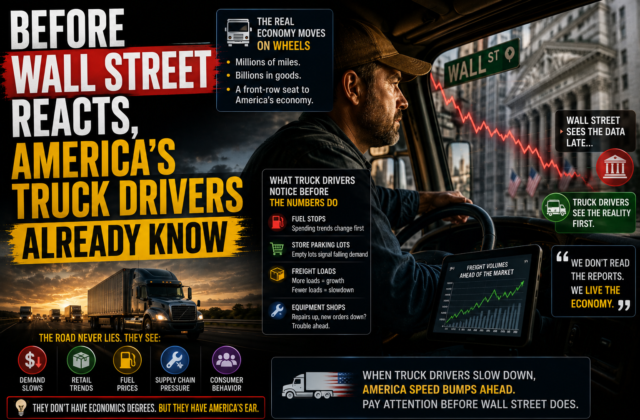
Before Wall Street Reacts, America’s Truck Drivers Already Know: The Hidden Economic Indicator Nobody Is Watching Every morning before the opening bell rings on Wall Street… Before economists publish GDP figures… Before the Federal Reserve discusses interest rates… Before television anchors begin talking about recessions… There is another group quietly reading the economy. America’s truck...
TheBusinessNow
Jul 21, 2026 · 3 min Read
Key Highlights
- 🚛 Nearly 72% of U.S. freight moves by truck, making the trucking industry one of the earliest indicators of economic activity.
- 📦 Truck drivers often notice changes in freight demand, warehouse activity, and retail orders before official economic reports are released.
- 📉 Rising empty trailers and lower freight volumes can signal slowing business activity across manufacturing and retail.
- ⛽ Diesel prices and freight rates influence transportation costs, which can eventually affect inflation and consumer prices.
- 📊 Many institutional investors monitor logistics and freight data alongside traditional indicators like GDP, employment, and inflation.
- 🤖 AI, GPS tracking, and fleet analytics are transforming trucking into a valuable source of real-time economic intelligence.
- 🌎 America's highways may reveal the direction of the economy weeks before Wall Street fully reacts.
Before Wall Street Reacts, America’s Truck Drivers Already Know: The Hidden Economic Indicator Nobody Is Watching
Every morning before the opening bell rings on Wall Street…
Before economists publish GDP figures…
Before the Federal Reserve discusses interest rates…
Before television anchors begin talking about recessions…
There is another group quietly reading the economy.
America’s truck drivers.
While investors analyze financial charts and economists debate inflation, nearly 3.5 million professional truck drivers are already moving—or not moving—the products that keep the U.S. economy alive.
Because almost 72% of all freight in the United States is transported by trucks, the trucking industry often provides one of the earliest real-world signals about where the economy may be heading.
The economy doesn’t begin on Wall Street.
It begins on America’s highways.
Why Trucks Matter More Than Stock Charts
Every physical product follows a journey.
A factory produces it.
A warehouse stores it.
A truck moves it.
A retailer sells it.
If fewer trucks are moving goods today…
Consumers may buy less tomorrow.
Businesses may earn less next quarter.
Investors may react weeks later.
That’s why many logistics experts describe freight demand as one of the economy’s earliest activity indicators.
The Economy Travels on 18 Wheels
Think about what truck drivers transport every day:
- Food
- Electronics
- Cars
- Medicine
- Construction materials
- Furniture
- Clothing
- Industrial equipment
If orders increase…
Truck loads increase.
If factories slow…
Truck loads disappear.
Truck drivers often notice these changes before they appear in government reports.
The First Warning Sign: Empty Trailers
One of the biggest concerns inside the trucking industry isn’t traffic.
It’s empty miles.
An empty mile occurs when a truck returns without cargo.
More empty trailers often mean:
- Fewer customer orders.
- Slower manufacturing.
- Weak retail demand.
- Lower industrial activity.
For trucking companies, rising empty miles reduce profitability.
For economists, they can indicate slowing economic momentum.
Warehouse Parking Lots Tell a Story
Truck drivers quickly notice changes at distribution centers.
Questions they ask include:
- Are docks crowded?
- Are trucks waiting longer?
- Are warehouses unusually quiet?
- Are loading bays operating around the clock?
These observations may provide clues about changes in inventory and shipping activity.
Retail Starts Here
Consumers often focus on store shelves.
Truck drivers see what happens before products ever arrive.
When retailers expect strong demand:
- More trucks are scheduled.
- Warehouses become busier.
- Delivery routes expand.
When retailers reduce orders:
Truck traffic can slow long before earnings reports reveal weaker sales.
Diesel Prices Matter More Than You Think
Every trucking company closely follows fuel costs.
Higher diesel prices can increase transportation expenses across industries.
Those costs may eventually affect:
- Grocery prices.
- Building materials.
- Online shopping.
- Manufacturing.
- Inflation.
Transportation costs can ripple through the economy because almost every physical product requires freight movement.
Freight Rates: A Hidden Market Signal
Another closely watched indicator is freight pricing.
When demand for shipping exceeds available trucks:
Freight rates typically rise.
When fewer businesses need transportation:
Freight rates may fall.
Analysts sometimes monitor freight markets because they reflect real business activity rather than investor sentiment.
Why Investors Are Paying Attention
Large investment firms increasingly analyze logistics-related data alongside traditional economic indicators.
Examples include:
- Freight volumes.
- Shipping demand.
- Warehouse activity.
- Truck utilization.
- Delivery times.
These metrics help provide a broader picture of supply chains and consumer demand.
The Amazon Effect
E-commerce has transformed freight.
Instead of moving products only to stores…
Companies now ship millions of individual packages directly to consumers.
This has increased the importance of:
- Regional warehouses.
- Last-mile delivery.
- Logistics technology.
- Fleet optimization.
Truck movement has become even more closely tied to consumer spending patterns.
The Technology Revolution Inside Trucking
Modern trucks generate enormous amounts of operational data.
Fleet management systems can monitor:
- Fuel efficiency.
- Delivery times.
- Route optimization.
- Traffic delays.
- Vehicle utilization.
Combined with artificial intelligence, these datasets help businesses improve logistics while offering additional insight into economic activity.
When Truck Drivers Become Economic Analysts
Experienced drivers often notice subtle changes, including:
- Fewer scheduled pickups.
- Shorter delivery routes.
- Reduced overtime.
- Slower warehouse operations.
- Different customer ordering patterns.
While these observations are anecdotal, they often align with broader shifts later reflected in official statistics.
Can Trucking Predict a Recession?
Not by itself.
Freight activity is only one part of the economic picture.
Many factors influence growth, including:
- Consumer spending.
- Interest rates.
- Employment.
- Inflation.
- Business investment.
- Global trade.
However, freight trends can serve as an early operational signal when combined with other indicators.
What Investors Should Watch
Professional investors increasingly monitor:
| Indicator | Why It Matters |
|---|---|
| Freight volumes | Business demand |
| Truck utilization | Manufacturing activity |
| Warehouse occupancy | Inventory trends |
| Diesel prices | Inflation pressure |
| Retail shipments | Consumer confidence |
| Logistics employment | Economic momentum |
| Delivery times | Supply chain conditions |
The Future of Economic Forecasting
Economic analysis is evolving.
Instead of relying only on monthly government reports…
Analysts increasingly combine:
- Freight data.
- Satellite imagery.
- Credit card spending.
- Shipping activity.
- AI analytics.
- Real-time logistics information.
The economy is becoming measurable almost as it happens.
Final Analysis
Wall Street may react first.
But America’s highways often move first.
Every truck leaving a factory…
Every trailer entering a warehouse…
Every shipment delivered to a retailer…
Represents another piece of the economic puzzle.
While truck drivers are not forecasting recessions or setting monetary policy, the freight networks they navigate every day provide valuable insight into how goods move, how businesses operate, and how consumers spend.
In an age of artificial intelligence and real-time data, one of the oldest industries in America continues to offer some of the most practical clues about the economy’s direction.
The next time markets debate whether growth is accelerating or slowing, remember this:
Some of the earliest signals may already be rolling down America’s highways.
📊 Quick Facts
| Metric | Insight |
|---|---|
| Share of U.S. freight moved by trucks | ~72% (by weight, according to industry estimates) |
| Professional truck drivers | Approximately 3.5 million |
| Industry impact | Supports retail, manufacturing, agriculture, healthcare, and construction |
| Economic role | Often reflects changes in goods movement before some macroeconomic reports are released |
❓FAQs
Why is trucking considered an economic indicator?
Because trucking transports the majority of U.S. freight, changes in shipping demand can reflect shifts in production, retail activity, and consumer demand.
Can truck drivers predict recessions?
No. Their observations cannot predict recessions on their own, but freight activity is one of several indicators analysts use to assess economic conditions.
Why do investors monitor freight data?
Freight volumes, delivery times, and logistics activity provide timely information about business operations and supply chain demand.
What affects trucking demand?
Consumer spending, manufacturing output, retail inventories, fuel prices, and overall economic activity all influence freight demand.
Is trucking still important in the era of e-commerce?
Yes. The growth of online shopping has made trucking even more important, particularly for warehouse distribution and last-mile delivery.
Keep reading
Related Articles
 Crypto
₿ Bitcoin Breaks Above $72,000: Why Trump’s Crypto Push Is Sending Crypto Stocks Higher
Bitcoin’s $72,000 Move Is Bigger Than Bitcoin A typical crypto headline would be: Bitcoin jumps above $72,000. But that misses the most important part of today’s move. The interesting part is the simultaneous rally in: Bitcoin ↓ Coinbase ↓ Strategy ↓ Circle ↓ Robinhood ↓ Bitcoin miners ↓ Crypto infrastructure That tells us investors aren’t...
 Markets
U.S. Treasury Doubles Bond Buybacks: Why Markets Are Still Worried About Rising Yields
The Treasury Just Sent Two Messages to Wall Street At first glance, this looks like a straightforward market-support operation. Treasury says: We want to improve liquidity in longer-dated Treasury securities. Investors hear: Washington is increasingly concerned about the rise in long-term borrowing costs. And that second interpretation is what makes this story important. The Treasury...
 Commodities
Oil Nears $95: Could the Iran War Trigger a New U.S. Inflation Shock?
Oil at $95 Is Not the Real Story A crude-oil headline is easy to write: “Oil prices rise as Iran tensions escalate.” Reuters, Bloomberg, CNBC and WSJ can publish that story within minutes. But for TheBusinessNow, that isn’t enough. The bigger question is: What happens to the American economy if oil stays near $95 —...
Comments (0)