
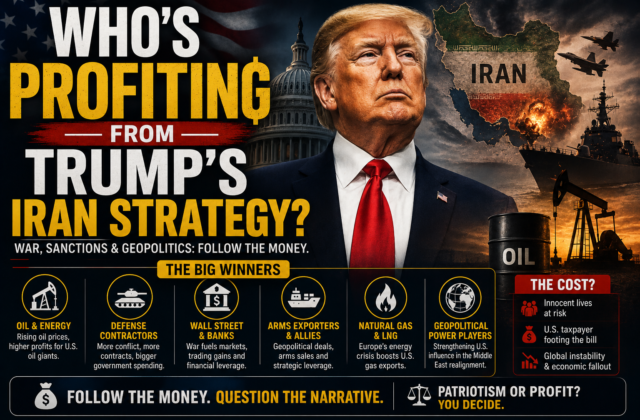
Who’s Profiting From Trump’s Iran Strategy? The Industries Quietly Winning as Middle East Tensions Reshape Global Markets
Who’s Profiting From Trump’s Iran Strategy? The Companies and Industries Quietly Winning as Global Markets React Every geopolitical crisis creates uncertainty. But it also creates winners. As President Donald Trump’s tougher stance toward Iran continues to influence global energy markets, defense planning, shipping routes, and investor sentiment, billions of dollars are flowing into sectors that...
TheBusinessNow
Jul 19, 2026 · 3 min Read
Key Highlights
- ⚡ Oil and energy markets often react quickly to Middle East tensions.
- 🛢️ Shipping routes around the Strait of Hormuz remain strategically important for global energy supplies.
- 🛡️ Defense companies may benefit from increased military spending and procurement.
- 🥇 Gold frequently attracts investors seeking traditional safe-haven assets during periods of uncertainty.
- 🚢 Alternative trade routes and logistics providers can see increased demand when normal shipping patterns are disrupted.
- 💻 Cybersecurity companies may gain attention as governments and businesses strengthen digital defenses.
Who’s Profiting From Trump’s Iran Strategy? The Companies and Industries Quietly Winning as Global Markets React
Every geopolitical crisis creates uncertainty.
But it also creates winners.
As President Donald Trump’s tougher stance toward Iran continues to influence global energy markets, defense planning, shipping routes, and investor sentiment, billions of dollars are flowing into sectors that stand to benefit from prolonged instability.
While headlines focus on military developments and diplomacy, Wall Street is watching something else entirely:
Where is the money going?
From defense contractors and oil exporters to cybersecurity firms and gold producers, several industries have experienced increased investor attention whenever tensions in the Middle East escalate.
The bigger question now is whether these gains will continue if geopolitical risks remain elevated.
Why Markets Pay Close Attention to Iran
Iran occupies one of the world’s most strategically significant regions.
The Strait of Hormuz is a key maritime route through which a substantial share of globally traded oil and liquefied natural gas passes.
Whenever tensions rise in the region, investors begin assessing potential impacts on:
- Energy prices
- Shipping costs
- Insurance premiums
- Commodity markets
- Global inflation
- Supply chains
Even without actual disruptions, expectations alone can influence financial markets.
1. Energy Companies
Oil prices are among the first assets to react during periods of geopolitical uncertainty.
If markets anticipate supply risks or transportation challenges, energy producers and integrated oil companies may attract investor interest.
Why?
- Potential supply concerns.
- Stronger crude prices.
- Improved cash flow if prices remain elevated.
- Increased investment in production and infrastructure.
2. Defense Contractors
Periods of heightened geopolitical tension often coincide with renewed attention to defense budgets.
Governments may accelerate spending on:
- Missile defense systems.
- Aircraft.
- Naval capabilities.
- Surveillance technology.
- Advanced communications.
- Ammunition and logistics.
Large defense contractors frequently remain in focus during such periods.
3. Gold Producers and Precious Metals
Gold has historically been viewed by many investors as a potential safe-haven asset during times of uncertainty.
When geopolitical risks increase, some investors shift portions of their portfolios toward precious metals in search of diversification.
That can also draw attention to gold mining companies and precious-metals producers.
4. Shipping and Logistics
Changes in regional security can affect global shipping patterns.
Companies involved in maritime transport, freight, and logistics may experience:
- Route adjustments.
- Higher freight rates.
- Increased insurance costs.
- Demand for alternative export corridors.
These developments can create both challenges and opportunities depending on market conditions.
5. Cybersecurity
Modern conflicts increasingly involve cyber threats alongside traditional military operations.
Governments and businesses often respond by increasing investment in:
- Threat detection.
- Network protection.
- Cloud security.
- Critical infrastructure resilience.
Cybersecurity firms therefore remain closely watched whenever geopolitical tensions rise.
Which Sectors Could Benefit?
| Sector | Potential Driver |
|---|---|
| Energy | Higher crude oil prices and stronger cash flows |
| Defense | Increased procurement and military spending |
| Gold & Precious Metals | Safe-haven demand during uncertainty |
| Shipping & Logistics | Alternative trade routes and higher freight activity |
| Cybersecurity | Greater demand for digital security solutions |
| Industrial Infrastructure | Potential investment in strategic supply chains |
Who Could Face Pressure?
Not every industry benefits from geopolitical uncertainty.
Some sectors may encounter additional challenges if energy costs rise or consumer confidence weakens.
| Sector | Potential Headwind |
|---|---|
| Airlines | Higher fuel costs |
| Cruise Operators | Travel demand uncertainty |
| Consumer Retail | Reduced discretionary spending |
| Manufacturing | More expensive energy and transport |
| Automotive | Supply-chain disruptions |
What Investors Are Watching
Markets are likely to focus on several key developments:
- Energy supply conditions.
- Shipping activity through strategic waterways.
- Defense budget announcements.
- Diplomatic negotiations.
- Commodity price movements.
- Central bank responses if energy prices influence inflation.
These factors may have a greater impact on markets than headlines alone.
Why This Story Is Trending
Search interest around “Trump Iran Strategy,” “Oil Prices,” “Defense Stocks,” and “Gold Outlook” has increased as investors evaluate how geopolitical developments could influence markets.
Rather than concentrating solely on politics, many market participants are assessing which industries may benefit or face new risks.
Final Analysis
Periods of geopolitical tension often reshape investment flows.
While uncertainty can weigh on broader markets, it may also increase interest in sectors linked to energy, defense, logistics, precious metals, and cybersecurity.
Whether these trends continue will depend on future developments, including diplomatic efforts, energy market conditions, and broader economic fundamentals.
For investors, the key lesson is to look beyond headlines and understand how geopolitical events can influence industries in different ways over time.
Frequently Asked Questions (FAQs)
Why do oil prices often react to Middle East tensions?
The region plays a major role in global energy production and transportation. Concerns about supply or shipping can influence market expectations.
Why is gold considered a safe-haven asset?
Many investors view gold as a potential store of value during periods of heightened uncertainty, although its price can still fluctuate.
Which industries may benefit from geopolitical tensions?
Energy, defense, cybersecurity, shipping, logistics, and precious-metals sectors often receive increased investor attention during such periods.
Does geopolitical uncertainty always help defense companies?
Not necessarily. Market performance depends on many factors, including government procurement decisions, contracts, and broader economic conditions.
Should investors change their portfolios because of geopolitical events?
Investment decisions should be based on individual goals, risk tolerance, and thorough research rather than short-term headlines.
About TheBusinessNow
TheBusinessNow delivers global coverage of business, finance, technology, geopolitics, commodities, and economic trends. Our goal is to provide readers with original, fact-based analysis that explains how world events shape markets and investment decisions.
Keep reading
Related Articles
 Crypto
₿ Bitcoin Breaks Above $72,000: Why Trump’s Crypto Push Is Sending Crypto Stocks Higher
Bitcoin’s $72,000 Move Is Bigger Than Bitcoin A typical crypto headline would be: Bitcoin jumps above $72,000. But that misses the most important part of today’s move. The interesting part is the simultaneous rally in: Bitcoin ↓ Coinbase ↓ Strategy ↓ Circle ↓ Robinhood ↓ Bitcoin miners ↓ Crypto infrastructure That tells us investors aren’t...
 Markets
U.S. Treasury Doubles Bond Buybacks: Why Markets Are Still Worried About Rising Yields
The Treasury Just Sent Two Messages to Wall Street At first glance, this looks like a straightforward market-support operation. Treasury says: We want to improve liquidity in longer-dated Treasury securities. Investors hear: Washington is increasingly concerned about the rise in long-term borrowing costs. And that second interpretation is what makes this story important. The Treasury...
 Commodities
Oil Nears $95: Could the Iran War Trigger a New U.S. Inflation Shock?
Oil at $95 Is Not the Real Story A crude-oil headline is easy to write: “Oil prices rise as Iran tensions escalate.” Reuters, Bloomberg, CNBC and WSJ can publish that story within minutes. But for TheBusinessNow, that isn’t enough. The bigger question is: What happens to the American economy if oil stays near $95 —...
Comments (0)