
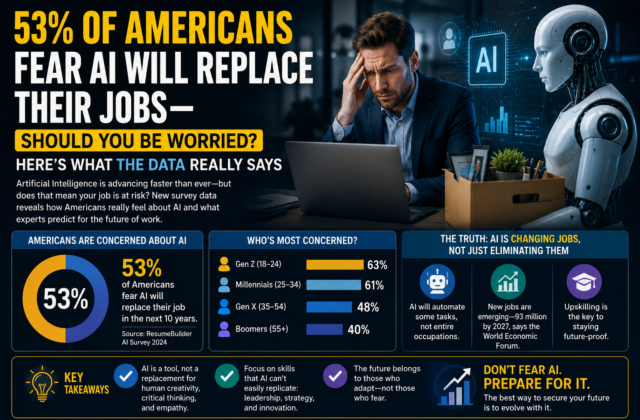
53% of Americans Fear AI Will Replace Their Jobs—Should You Be Worried? Here’s What the Data Really Says
53% of Americans Fear AI Will Replace Their Jobs—Should You Be Worried? Here’s What the Data Really Says Artificial Intelligence is no longer a futuristic concept—it has become one of the biggest forces reshaping workplaces across the world. From customer service chatbots and AI-powered coding assistants to automated content creation and intelligent data analysis, businesses...
TheBusinessNow
Jul 18, 2026 · 4 min Read
Key Highlights
- 🤖 53% of Americans believe AI could replace their jobs.
- 💼 Companies are rapidly integrating AI into everyday business operations.
- 📈 Demand for AI-related skills continues to rise globally.
- 🏢 White-collar professions are increasingly affected by automation.
- 💰 Businesses view AI as a major productivity and cost-saving tool.
- 🌍 Experts say workers who adapt to AI are likely to remain competitive.
53% of Americans Fear AI Will Replace Their Jobs—Should You Be Worried? Here’s What the Data Really Says
Artificial Intelligence is no longer a futuristic concept—it has become one of the biggest forces reshaping workplaces across the world.
From customer service chatbots and AI-powered coding assistants to automated content creation and intelligent data analysis, businesses are adopting AI at an unprecedented pace. While companies see massive productivity gains, millions of workers are asking a different question:
Will AI eventually replace my job?
A recent survey has intensified that debate after revealing that 53% of Americans believe Artificial Intelligence could replace their jobs during their working lifetime.
The finding reflects growing public anxiety as AI becomes more capable of performing tasks that once required human expertise.
But is this fear justified?
Or is AI creating as many opportunities as it is eliminating?
Here’s what the latest data, industry experts, and hiring trends reveal.
Why Are So Many Americans Worried About AI?
Just a few years ago, automation primarily affected repetitive manufacturing work.
Today, AI is transforming professions that were once considered secure.
Modern AI systems can now:
- Write reports
- Analyze financial data
- Generate software code
- Answer customer questions
- Create presentations
- Translate languages
- Produce marketing content
- Review legal documents
- Assist doctors with diagnostics
This rapid expansion has changed public perception.
Instead of asking whether AI can perform human tasks, many workers are now asking how quickly it will become part of their own workplace.
The Rise of AI in the Workplace
Businesses across nearly every industry are investing heavily in artificial intelligence.
Major technology companies continue introducing increasingly powerful AI models capable of completing complex professional tasks in seconds.
Organizations are using AI to:
- Improve efficiency
- Reduce operating costs
- Speed up decision-making
- Enhance customer service
- Automate repetitive workflows
- Support employees with research and analysis
Rather than replacing every worker outright, many businesses are redesigning jobs so employees work alongside AI systems.
Which Jobs Face the Highest AI Risk?
While AI is unlikely to replace every profession, some occupations are more exposed than others.
Industries experiencing the fastest automation include:
Administrative Support
Routine paperwork, scheduling, and document processing can increasingly be handled by AI.
Customer Service
AI chatbots and virtual assistants now resolve many common customer requests without human intervention.
Data Entry
Repetitive information processing is one of the easiest functions to automate.
Basic Content Creation
AI tools can quickly generate summaries, marketing drafts, and product descriptions.
Entry-Level Programming
AI coding assistants are helping developers write, debug, and optimize software faster than ever before.
Which Jobs Are Likely to Remain Safe?
Experts believe careers requiring human judgment, creativity, empathy, and physical interaction remain relatively resilient.
These include:
- Healthcare professionals
- Nurses
- Surgeons
- Electricians
- Plumbers
- Skilled technicians
- Teachers
- Psychologists
- Social workers
- Emergency responders
- Creative directors
- Scientists
- Entrepreneurs
AI may support these professions but is less likely to fully replace them.
The Biggest Shift Isn’t Job Loss—It’s Job Transformation
One of the biggest misconceptions is that AI will simply eliminate jobs.
History suggests technological revolutions usually transform work rather than eliminate it entirely.
The internet created entirely new industries.
Cloud computing generated millions of technology jobs.
Smartphones produced an entire app economy.
AI may follow a similar path.
Instead of replacing entire professions, AI is expected to automate specific tasks, allowing workers to focus on higher-value responsibilities.
Companies Want Employees Who Can Use AI
Hiring trends increasingly show employers value workers who understand AI tools.
Employees capable of working with AI often become:
- More productive
- Faster decision-makers
- Better researchers
- Stronger problem-solvers
Learning how to use AI effectively may become as important as learning Microsoft Office was two decades ago.
What Skills Will Matter Most?
Experts suggest workers should focus on developing skills AI struggles to replicate.
These include:
Critical Thinking
Making complex decisions beyond data analysis.
Communication
Building relationships and influencing people.
Leadership
Managing teams and strategic planning.
Creativity
Generating original ideas and innovation.
Emotional Intelligence
Understanding human emotions and collaboration.
AI Literacy
Knowing how to work with AI tools instead of competing against them.
Why Investors Are Betting Big on AI
The AI boom extends beyond workplaces.
Investors continue pouring billions of dollars into companies building AI infrastructure, chips, software, and enterprise tools.
Major technology firms are competing aggressively to dominate the next generation of artificial intelligence.
This investment wave is creating thousands of new jobs in:
- AI engineering
- Machine learning
- Data science
- Robotics
- Cybersecurity
- Cloud computing
Could AI Create More Jobs Than It Replaces?
Many economists believe that while certain roles will disappear, entirely new professions will emerge.
Examples include:
- AI trainers
- Prompt engineers
- AI auditors
- AI ethics specialists
- Machine learning engineers
- AI compliance managers
- Human-AI workflow designers
Previous technological revolutions suggest adaptation—not resistance—often leads to the greatest career opportunities.
Should You Actually Be Worried?
The answer depends largely on your willingness to adapt.
Workers who continuously develop new skills, embrace AI tools, and stay informed about technological change are likely to remain highly valuable.
Those who ignore AI altogether may find themselves at greater risk as automation continues expanding across industries.
The future of work is unlikely to be humans versus AI.
Instead, it will increasingly become humans working with AI.
Final Thoughts
The finding that 53% of Americans fear AI will replace their jobs reflects a rapidly changing workplace rather than an inevitable employment crisis.
Artificial intelligence is transforming industries at extraordinary speed, but history shows technological progress rarely eliminates work altogether. Instead, it changes the skills employers value and creates entirely new career paths.
For workers, the most effective strategy is not fear—it is preparation.
Learning AI, improving uniquely human skills, and remaining adaptable may become the greatest competitive advantages of the next decade.
As businesses continue investing billions into artificial intelligence, the future will likely belong to those who understand how to work alongside the technology rather than compete against it.
Frequently Asked Questions (FAQs)
Will AI replace every job?
No. AI is expected to automate many tasks, but most experts believe many jobs will evolve rather than disappear completely.
Which careers are most vulnerable to AI?
Administrative support, data entry, routine customer service, and repetitive office tasks face higher automation risks.
Which jobs are safest from AI?
Healthcare, skilled trades, education, leadership, emergency services, and creative professions remain relatively resilient.
Is learning AI now important?
Yes. AI literacy is becoming one of the fastest-growing workplace skills across industries.
Can AI create new jobs?
Yes. AI is already creating demand for machine learning engineers, AI auditors, prompt engineers, data scientists, and other emerging roles.
About TheBusinessNow
TheBusinessNow delivers global coverage of business, finance, technology, geopolitics, commodities, and economic trends. Our goal is to provide readers with original, fact-based analysis that explains how world events shape markets and investment decisions.
Keep reading
Related Articles
 Crypto
₿ Bitcoin Breaks Above $72,000: Why Trump’s Crypto Push Is Sending Crypto Stocks Higher
Bitcoin’s $72,000 Move Is Bigger Than Bitcoin A typical crypto headline would be: Bitcoin jumps above $72,000. But that misses the most important part of today’s move. The interesting part is the simultaneous rally in: Bitcoin ↓ Coinbase ↓ Strategy ↓ Circle ↓ Robinhood ↓ Bitcoin miners ↓ Crypto infrastructure That tells us investors aren’t...
 Markets
U.S. Treasury Doubles Bond Buybacks: Why Markets Are Still Worried About Rising Yields
The Treasury Just Sent Two Messages to Wall Street At first glance, this looks like a straightforward market-support operation. Treasury says: We want to improve liquidity in longer-dated Treasury securities. Investors hear: Washington is increasingly concerned about the rise in long-term borrowing costs. And that second interpretation is what makes this story important. The Treasury...
 Commodities
Oil Nears $95: Could the Iran War Trigger a New U.S. Inflation Shock?
Oil at $95 Is Not the Real Story A crude-oil headline is easy to write: “Oil prices rise as Iran tensions escalate.” Reuters, Bloomberg, CNBC and WSJ can publish that story within minutes. But for TheBusinessNow, that isn’t enough. The bigger question is: What happens to the American economy if oil stays near $95 —...
Comments (0)