
US Jobs and Retail Sales Data: Jobless Claims Beat Forecasts While Retail Sales Growth Slows
US Jobs and Retail Sales Data Signals a Strong Labor Market but Slower Consumer Spending US Jobs and Retail Sales Data released on July 16, 2026, painted a mixed picture of the U.S. economy. The labor market remained resilient as Initial Jobless Claims dropped to 208,000, beating economists’ expectations of 217,000 and improving from the...
TheBusinessNow
Jul 16, 2026 · 3 min Read
Key Highlights
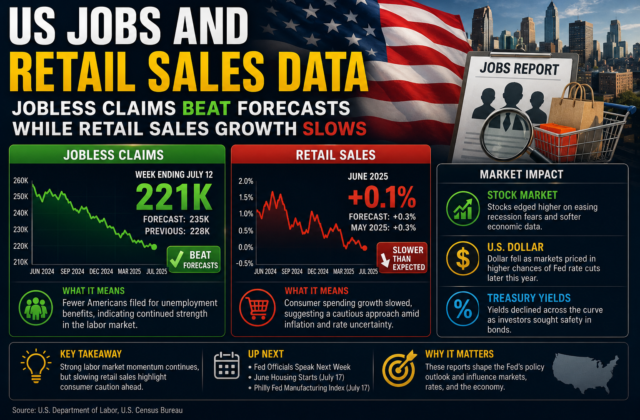
- 🇺🇸 US Jobs and Retail Sales Data released on July 16, 2026.
- 📉 Initial Jobless Claims came in at 208K.
- ✅ Better than the market estimate of 217K.
- 📊 Previous week's claims were 215K.
- 👷 Continuing Jobless Claims eased to 1.805 million from 1.814 million.
- 🛍️ Retail Sales (MoM) increased 0.2% in June.
- 📈 Retail Sales matched analyst expectations.
- 📉 June Retail Sales slowed from 0.9% recorded previously.
- 💵 Markets continue assessing the impact on future Fed policy.
US Jobs and Retail Sales Data Signals a Strong Labor Market but Slower Consumer Spending
US Jobs and Retail Sales Data released on July 16, 2026, painted a mixed picture of the U.S. economy. The labor market remained resilient as Initial Jobless Claims dropped to 208,000, beating economists’ expectations of 217,000 and improving from the previous week’s 215,000.
Meanwhile, Retail Sales (MoM) increased 0.2% in June, matching market expectations but slowing significantly from the previous 0.9% growth. The latest US Jobs and Retail Sales Data suggests that while employment conditions remain healthy, consumer spending is beginning to moderate.
The data could play an important role in shaping expectations for future Federal Reserve interest rate decisions, with investors closely watching signs of economic cooling without a sharp slowdown.
US Jobs and Retail Sales Data: Labor Market Remains Strong
The latest US Jobs and Retail Sales Data indicates that the U.S. labor market continues to show resilience.
Initial Jobless Claims—a closely watched measure of layoffs—fell to 208,000, significantly below expectations. Lower claims generally indicate that employers are retaining workers and that layoffs remain limited despite higher interest rates.
Continuing Jobless Claims also improved, falling to 1.805 million compared with 1.814 million previously, suggesting that unemployed workers are finding new jobs relatively quickly.
US Jobs and Retail Sales Data: Consumer Spending Moderates
While employment remained strong, the US Jobs and Retail Sales Data showed signs of slower consumer spending.
Retail Sales rose 0.2% month-over-month, exactly matching market forecasts but cooling from May’s stronger 0.9% increase.
The moderation suggests consumers continue to spend but at a more measured pace, likely reflecting the impact of elevated borrowing costs and persistent inflation pressures.
Economic Data Snapshot
| Indicator | Actual | Forecast | Previous |
|---|---|---|---|
| Initial Jobless Claims | 208K | 217K | 215K |
| Continuing Jobless Claims | 1.805M | — | 1.814M |
| Retail Sales (MoM) | 0.2% | 0.2% | 0.9% |
Market Reaction to the US Jobs and Retail Sales Data
The latest economic figures may have several implications for financial markets.
- A stronger labor market supports economic growth.
- Slower retail sales indicate demand is cooling gradually.
- Treasury yields could remain sensitive to future economic releases.
- The U.S. dollar may stay supported by solid employment data.
- Equity markets could focus on whether the economy achieves a “soft landing.”
Investors will continue monitoring upcoming inflation reports and additional labor market indicators before reassessing Federal Reserve expectations.
What the Data Means for the Federal Reserve
The US Jobs and Retail Sales Data presents a balanced economic picture.
On one hand, stronger-than-expected employment data suggests the economy remains resilient. On the other, slower retail sales growth may indicate that higher interest rates are gradually reducing consumer demand.
This combination could support the Federal Reserve’s cautious approach as policymakers evaluate whether inflation continues moving toward its target without causing a sharp economic slowdown.
What Investors Should Watch Next
Following the US Jobs and Retail Sales Data, markets will closely monitor:
- Upcoming U.S. inflation reports
- Federal Reserve officials’ comments
- GDP growth estimates
- Consumer confidence data
- Manufacturing activity
- Corporate earnings season
These indicators will provide further insight into the direction of the U.S. economy during the second half of 2026.
Conclusion
The latest US Jobs and Retail Sales Data highlights an economy that remains resilient but is beginning to show signs of moderating consumer demand. Initial Jobless Claims falling to 208K underscore continued labor market strength, while Retail Sales growth of 0.2% reflects slower—but still positive—consumer spending. Investors will now look to upcoming economic releases and Federal Reserve guidance for clues on the future path of interest rates.
Frequently Asked Questions
What did the latest US Jobs and Retail Sales Data show?
The latest US Jobs and Retail Sales Data showed Initial Jobless Claims falling to 208K, while Retail Sales increased 0.2% in June.
Why are Initial Jobless Claims important?
Initial Jobless Claims measure new applications for unemployment benefits and provide an early indication of labor market strength.
How did Retail Sales perform?
Retail Sales increased 0.2%, matching forecasts but slowing from the previous month’s 0.9% growth.
What does the US Jobs and Retail Sales Data mean for the Federal Reserve?
The data suggests a strong labor market alongside moderating consumer spending, supporting a cautious approach to future monetary policy.
Read More – Gurnoor Brar ICC Reprimand: India Pacer Warned for Level 1 Code of Conduct Breach Ahead of 2nd ODI
Calculate Live Gold Price – Gold Calculator
Check Economic Calendar Live
Keep reading
Related Articles
 Crypto
₿ Bitcoin Breaks Above $72,000: Why Trump’s Crypto Push Is Sending Crypto Stocks Higher
Bitcoin’s $72,000 Move Is Bigger Than Bitcoin A typical crypto headline would be: Bitcoin jumps above $72,000. But that misses the most important part of today’s move. The interesting part is the simultaneous rally in: Bitcoin ↓ Coinbase ↓ Strategy ↓ Circle ↓ Robinhood ↓ Bitcoin miners ↓ Crypto infrastructure That tells us investors aren’t...
 Markets
U.S. Treasury Doubles Bond Buybacks: Why Markets Are Still Worried About Rising Yields
The Treasury Just Sent Two Messages to Wall Street At first glance, this looks like a straightforward market-support operation. Treasury says: We want to improve liquidity in longer-dated Treasury securities. Investors hear: Washington is increasingly concerned about the rise in long-term borrowing costs. And that second interpretation is what makes this story important. The Treasury...
 Commodities
Oil Nears $95: Could the Iran War Trigger a New U.S. Inflation Shock?
Oil at $95 Is Not the Real Story A crude-oil headline is easy to write: “Oil prices rise as Iran tensions escalate.” Reuters, Bloomberg, CNBC and WSJ can publish that story within minutes. But for TheBusinessNow, that isn’t enough. The bigger question is: What happens to the American economy if oil stays near $95 —...
Comments (0)