
Why Did SpaceX’s Falcon 9 Create a Giant “Space Jellyfish”? The Science Behind the Viral Sky Phenomenon
When SpaceX’s Falcon 9 rocket blasted off from Florida in the early hours of Thursday morning, the mission itself was already making history. The reusable booster completed its 36th successful flight, extending its own record and once again proving why SpaceX remains the global leader in reusable rocket technology. But while aerospace engineers celebrated another...
TheBusinessNow
Jul 9, 2026 · 4 min Read
Key Highlights
- 🚀 SpaceX's Falcon 9 completed a historic 36th flight, extending the record for the most flights by a reusable orbital rocket booster.
- 🌌 A spectacular "space jellyfish" appeared in the sky, becoming one of the most viral moments of the launch.
- ☀️ The glowing effect occurs when sunlight illuminates the rocket's exhaust plume at high altitude, even while the ground remains dark.
- 📸 Thousands of people across Florida captured and shared breathtaking images of the phenomenon on social media.
- 🔬 The event demonstrated both the beauty of atmospheric science and the engineering behind reusable rocket technology.
- 📈 As SpaceX pushes reusable rocket technology further, records like the 36th successful flight may soon be broken again by the company itself.
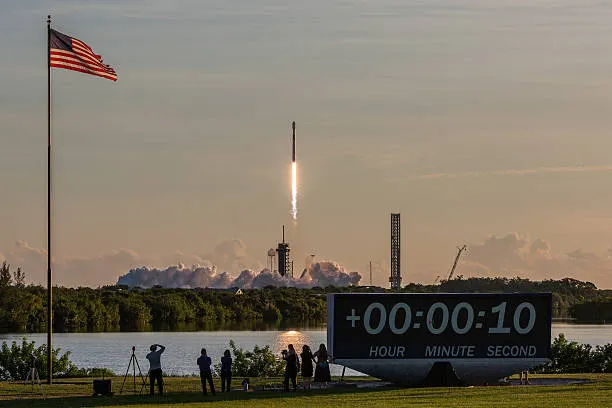
When SpaceX’s Falcon 9 rocket blasted off from Florida in the early hours of Thursday morning, the mission itself was already making history. The reusable booster completed its 36th successful flight, extending its own record and once again proving why SpaceX remains the global leader in reusable rocket technology.
But while aerospace engineers celebrated another flawless launch, millions of people online were captivated by something entirely different.
A massive glowing object appeared in the pre-dawn sky over Florida, stretching across the horizon like a luminous jellyfish floating through space. Within minutes, social media platforms such as X, Instagram, TikTok, and Facebook were flooded with breathtaking photos and videos. Many viewers wondered if they had witnessed a rare atmospheric event—or something even more mysterious.
The truth, however, is rooted in science, and it’s every bit as fascinating as the images themselves.
A Historic Milestone for SpaceX
The launch marked another major achievement for SpaceX’s Falcon 9 program.
The booster successfully completed its 36th mission, making it the most frequently flown orbital-class rocket booster in history. Just over a decade ago, rockets were considered disposable machines, used only once before falling into the ocean or burning up in Earth’s atmosphere.
SpaceX changed that philosophy.
By designing rockets that can return safely to Earth, undergo inspections, and fly again, the company has dramatically reduced launch costs while increasing the frequency of missions.
This latest success further strengthens SpaceX’s reputation as the pioneer of reusable spaceflight and demonstrates how reliable reusable rockets have become.
Why Everyone Was Talking About the Sky Instead of the Rocket
Although the mission itself was technically impressive, the internet quickly focused on one spectacular visual.
Moments after liftoff, a brilliant white cloud expanded high above the atmosphere, glowing against the dark morning sky. Long, flowing trails extended behind it, making it resemble a giant jellyfish drifting through space.
For many people seeing it for the first time, the sight looked almost supernatural.
Searches immediately surged for questions such as:
- Why did the SpaceX rocket look like a jellyfish?
- What is the glowing cloud after a rocket launch?
- Why was the sky glowing after the Falcon 9 launch?
- Is the SpaceX jellyfish effect real?
The answer lies in the unique conditions surrounding rocket launches during twilight.
The Science Behind the “Space Jellyfish”
Despite its unusual appearance, the “space jellyfish” is a completely natural phenomenon created by physics.
When Falcon 9 climbs to an altitude of more than 100 kilometers, it reaches a region where sunlight is still shining on the rocket—even though people on the ground may still be in darkness before sunrise or after sunset.
As the rocket engines continue firing, they release enormous amounts of exhaust gases.
At those extreme altitudes:
- The atmosphere is incredibly thin.
- The exhaust expands rapidly into a massive cloud.
- Tiny particles of water vapor and ice crystals scatter sunlight.
- The illuminated exhaust plume glows brilliantly against the dark sky.
Because the expanding cloud spreads outward while the rocket continues moving forward, it creates a rounded “bell” with long trailing streams beneath it, giving the appearance of a floating jellyfish.
Far from being unusual or dangerous, this phenomenon is actually one of the most beautiful examples of atmospheric optics produced by modern spaceflight.
Why Doesn’t Every SpaceX Launch Create This Effect?
If Falcon 9 launches happen so frequently, why don’t we see a glowing jellyfish every time?
The answer is timing.
The phenomenon only appears when several conditions occur simultaneously.
1. Twilight Launch
The rocket must launch shortly before sunrise or shortly after sunset.
2. Clear Weather
Cloud cover can hide the illuminated exhaust plume.
3. High Altitude
The rocket needs to climb high enough that sunlight reaches it while the ground below remains dark.
4. Observer Location
People directly beneath or near the launch path enjoy the best view.
When these factors align, the result is one of the most stunning natural-looking displays created by human technology.
Why Falcon 9’s 36th Flight Matters
While the glowing sky captured attention worldwide, the true story is what Falcon 9’s latest achievement represents for the future of space exploration.
Flying a rocket booster 36 times would have sounded impossible just twenty years ago.
Today, it has become reality.
Reusable rockets offer several major advantages:
- Lower launch costs for governments and private companies.
- Faster turnaround between missions.
- Reduced manufacturing waste.
- Increased access to space for scientific research.
- More affordable satellite deployment.
Each successful reuse helps make spaceflight more sustainable and economically viable.
SpaceX Is Redefining the Economics of Space
Every successful Falcon 9 mission reinforces one simple idea:
Reusable rockets are no longer experimental—they are the future.
By recovering and reusing boosters dozens of times, SpaceX has dramatically reduced the cost of putting satellites, scientific payloads, and astronauts into orbit.
This has enabled:
- More Starlink launches.
- More commercial satellite missions.
- Faster scientific research.
- Increased competition in the global launch industry.
Other aerospace companies are now investing heavily in reusable rocket technology, following the model that SpaceX pioneered.
Why the “Space Jellyfish” Went Viral
The internet loves spectacular visuals, and the Falcon 9 launch delivered exactly that.
Thousands of users shared photos showing the glowing cloud stretching across the sky.
Many initially mistook it for:
- A UFO
- An aurora
- A meteor
- A rare weather event
- A mysterious atmospheric phenomenon
Once experts explained the science, fascination only grew.
Unlike many viral internet moments, this one combined breathtaking imagery with genuine scientific curiosity.
For educators, astronomy enthusiasts, and casual viewers alike, it became a reminder of how modern space exploration can inspire millions.
What Happens Next for Falcon 9?
With another flawless mission completed, Falcon 9 continues to set the standard for operational reliability.
As SpaceX increases its launch cadence throughout 2026, additional milestones are expected, including more commercial missions, Starlink deployments, and preparations for future deep-space exploration.
If the current pace continues, today’s record of 36 flights may soon be surpassed by the very same booster.
Final Thoughts
SpaceX’s latest Falcon 9 mission will be remembered for two reasons.
First, it demonstrated once again that reusable rockets have fundamentally changed the economics of spaceflight.
Second, it produced one of the most breathtaking sights seen in recent launches—a glowing “space jellyfish” that transformed an engineering achievement into a viral global spectacle.
For millions watching from the ground, it wasn’t just another rocket launch.
It was a reminder that science can still surprise us, inspire us, and create moments that feel almost otherworldly.
As SpaceX continues pushing the boundaries of reusable space technology, spectacular displays like this may become more common—but they will never stop capturing the world’s imagination.
Frequently Asked Questions (FAQ)
Why did the SpaceX rocket look like a jellyfish?
The glowing “space jellyfish” forms when the Falcon 9 rocket reaches high altitude and its exhaust plume is illuminated by sunlight while the ground below remains in darkness.
Is the SpaceX jellyfish dangerous?
No. It is a harmless visual phenomenon caused by sunlight reflecting off the rocket’s expanding exhaust gases.
Why was Falcon 9’s 36th flight significant?
It marked the highest number of successful flights by a single orbital-class reusable rocket booster, showcasing the reliability of SpaceX’s reusable launch technology.
Can the space jellyfish be seen outside Florida?
Yes. Depending on weather conditions and the launch trajectory, similar effects can sometimes be visible hundreds of miles away.
Will Falcon 9 break its own flight record?
Given SpaceX’s continued success with booster recovery and refurbishment, industry experts expect the current record to be surpassed in future missions.
About TheBusinessNow
TheBusinessNow delivers global coverage of business, finance, technology, geopolitics, commodities, and economic trends. Our goal is to provide readers with original, fact-based analysis that explains how world events shape markets and investment decisions.
Keep reading
Related Articles
 Crypto
₿ Bitcoin Breaks Above $72,000: Why Trump’s Crypto Push Is Sending Crypto Stocks Higher
Bitcoin’s $72,000 Move Is Bigger Than Bitcoin A typical crypto headline would be: Bitcoin jumps above $72,000. But that misses the most important part of today’s move. The interesting part is the simultaneous rally in: Bitcoin ↓ Coinbase ↓ Strategy ↓ Circle ↓ Robinhood ↓ Bitcoin miners ↓ Crypto infrastructure That tells us investors aren’t...
 Markets
U.S. Treasury Doubles Bond Buybacks: Why Markets Are Still Worried About Rising Yields
The Treasury Just Sent Two Messages to Wall Street At first glance, this looks like a straightforward market-support operation. Treasury says: We want to improve liquidity in longer-dated Treasury securities. Investors hear: Washington is increasingly concerned about the rise in long-term borrowing costs. And that second interpretation is what makes this story important. The Treasury...
 Commodities
Oil Nears $95: Could the Iran War Trigger a New U.S. Inflation Shock?
Oil at $95 Is Not the Real Story A crude-oil headline is easy to write: “Oil prices rise as Iran tensions escalate.” Reuters, Bloomberg, CNBC and WSJ can publish that story within minutes. But for TheBusinessNow, that isn’t enough. The bigger question is: What happens to the American economy if oil stays near $95 —...
Comments (0)