
Mortgage Rates Today (July 9, 2026): Falling Rates Offer Relief for Homebuyers and Homeowners
Mortgage Rates Continue to Fall, Giving Buyers a Welcome Break After months of elevated borrowing costs, U.S. mortgage rates are continuing their gradual decline, providing encouraging news for both prospective homebuyers and homeowners considering refinancing. The latest market trends show that mortgage rates have eased for several consecutive sessions, helping improve affordability in a housing...
TheBusinessNow
Jul 9, 2026 · 5 min Read
Key Highlights
- 🏡 U.S. mortgage rates continued to decline heading into July 9, 2026.
- 📉 Falling Treasury yields and easing inflation are supporting lower borrowing costs.
- 💰 Lower rates could reduce monthly payments for new homebuyers.
- 🔄 Refinancing activity may increase as homeowners look to lock in better rates.
- 📊 Future mortgage movements will depend on inflation, Federal Reserve policy, and broader economic data.
- 🏠 Lower rates could provide a boost to the U.S. housing market during the second half of 2026.
Mortgage Rates Continue to Fall, Giving Buyers a Welcome Break
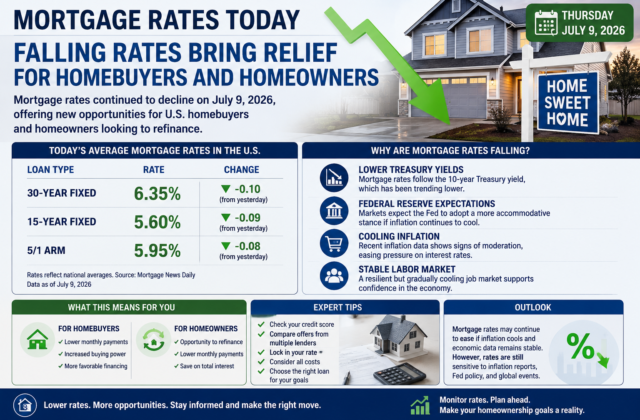
After months of elevated borrowing costs, U.S. mortgage rates are continuing their gradual decline, providing encouraging news for both prospective homebuyers and homeowners considering refinancing.
The latest market trends show that mortgage rates have eased for several consecutive sessions, helping improve affordability in a housing market that has remained challenging due to high home prices and elevated financing costs.
While rates remain above the historic lows seen during the pandemic, the recent decline is giving many Americans a renewed opportunity to enter the housing market or lower their monthly payments through refinancing.
Why Are Mortgage Rates Falling?
Several economic factors are contributing to the recent decline in mortgage rates:
📉 Lower Treasury Yields
Mortgage rates closely follow the yield on the 10-year U.S. Treasury note. As Treasury yields have softened, lenders have gradually lowered mortgage rates.
🏦 Federal Reserve Expectations
Investors increasingly expect the Federal Reserve to adopt a more accommodative stance if inflation continues to cool. While the Fed does not directly set mortgage rates, expectations around future monetary policy influence bond markets and borrowing costs.
📊 Cooling Inflation
Recent inflation data has shown signs of moderation, easing concerns that interest rates will remain elevated for an extended period.
💵 Stable Labor Market
A resilient but gradually cooling labor market has also helped improve investor confidence that inflation can continue easing without triggering a severe economic slowdown.
What This Means for Homebuyers
The recent decline in mortgage rates could make purchasing a home more affordable.
Lower interest rates may offer several benefits:
- 🏡 Lower monthly mortgage payments
- 💰 Increased purchasing power
- 📈 Better loan qualification opportunities
- 🔑 More favorable financing conditions
Even a small reduction in mortgage rates can save borrowers thousands of dollars over the life of a home loan.
Is It a Good Time to Refinance?
For homeowners who purchased or refinanced their homes when rates were higher, today’s market may present an opportunity to refinance.
Refinancing may help homeowners:
- Reduce monthly payments
- Lower total interest costs
- Switch from an adjustable-rate mortgage (ARM) to a fixed-rate loan
- Shorten the loan term
- Access home equity through cash-out refinancing, if appropriate
However, borrowers should compare closing costs, loan terms, and potential savings before making a decision.
Housing Market Outlook
The U.S. housing market remains competitive despite affordability challenges.
Lower mortgage rates could:
- Encourage more first-time buyers to enter the market
- Increase demand for existing homes
- Improve refinancing activity
- Support homebuilder confidence
- Boost overall housing market activity during the second half of 2026
At the same time, limited housing inventory in many regions may continue to put upward pressure on home prices.
What Buyers Should Watch Next
Several key economic events could influence mortgage rates in the coming weeks:
- Federal Reserve policy decisions
- Consumer Price Index (CPI) inflation reports
- Employment and jobs data
- Retail sales figures
- Treasury yield movements
- Housing market reports
Unexpected changes in these indicators could cause mortgage rates to move higher or lower.
Expert Tips Before Applying for a Mortgage
If you’re planning to buy a home or refinance, consider these steps:
- ✅ Check your credit score before applying.
- ✅ Compare offers from multiple lenders.
- ✅ Lock in your interest rate if favorable terms are available.
- ✅ Factor in closing costs and fees.
- ✅ Determine whether a fixed-rate or adjustable-rate mortgage best fits your financial goals.
Shopping around can often lead to better loan terms and long-term savings.
Could Mortgage Rates Fall Further?
Many housing analysts believe mortgage rates may continue to ease if inflation keeps slowing and financial markets expect future interest rate cuts.
However, mortgage rates remain sensitive to economic data and global events. Strong inflation readings or unexpected shifts in Federal Reserve policy could quickly reverse the recent downward trend.
Borrowers should remain flexible and monitor market conditions before making financing decisions.
Bottom Line
The continued decline in U.S. mortgage rates is providing much-needed relief for homebuyers and homeowners alike. While borrowing costs remain higher than the record lows of previous years, the recent improvement in financing conditions is helping restore confidence in the housing market.
For buyers, lower rates may improve affordability and purchasing power. For existing homeowners, refinancing could become a cost-saving opportunity if the numbers work in their favor. As always, comparing lenders, understanding loan terms, and staying informed about economic developments remain essential before making any mortgage decision.
About TheBusinessNow
TheBusinessNow delivers global coverage of business, finance, technology, geopolitics, commodities, and economic trends. Our goal is to provide readers with original, fact-based analysis that explains how world events shape markets and investment decisions.
Keep reading
Related Articles
 Crypto
₿ Bitcoin Breaks Above $72,000: Why Trump’s Crypto Push Is Sending Crypto Stocks Higher
Bitcoin’s $72,000 Move Is Bigger Than Bitcoin A typical crypto headline would be: Bitcoin jumps above $72,000. But that misses the most important part of today’s move. The interesting part is the simultaneous rally in: Bitcoin ↓ Coinbase ↓ Strategy ↓ Circle ↓ Robinhood ↓ Bitcoin miners ↓ Crypto infrastructure That tells us investors aren’t...
 Markets
U.S. Treasury Doubles Bond Buybacks: Why Markets Are Still Worried About Rising Yields
The Treasury Just Sent Two Messages to Wall Street At first glance, this looks like a straightforward market-support operation. Treasury says: We want to improve liquidity in longer-dated Treasury securities. Investors hear: Washington is increasingly concerned about the rise in long-term borrowing costs. And that second interpretation is what makes this story important. The Treasury...
 Commodities
Oil Nears $95: Could the Iran War Trigger a New U.S. Inflation Shock?
Oil at $95 Is Not the Real Story A crude-oil headline is easy to write: “Oil prices rise as Iran tensions escalate.” Reuters, Bloomberg, CNBC and WSJ can publish that story within minutes. But for TheBusinessNow, that isn’t enough. The bigger question is: What happens to the American economy if oil stays near $95 —...
Comments (0)