
Federal Reserve Faces Transparency Questions as J.P. Morgan Warns of “Diminished Communications” Risk
J.P. Morgan Raises Concerns Over Federal Reserve’s Communication Strategy J.P. Morgan has warned that changes in the Federal Reserve’s communication approach could make financial markets more volatile and reduce transparency for investors. The concern comes ahead of the release of the June Federal Open Market Committee (FOMC) meeting minutes, which analysts believe could provide the...
TheBusinessNow
Jul 8, 2026 · 5 min Read
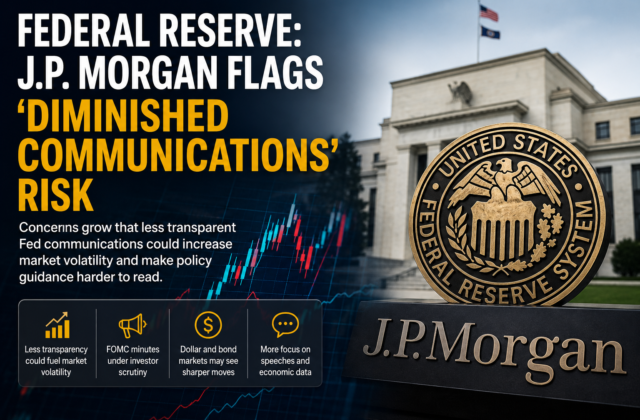
Key Highlights
- 🏦 J.P. Morgan has raised concerns about reduced transparency in Federal Reserve communications.
- 📄 Investors are awaiting the June FOMC meeting minutes for clues on future policy messaging.
- 📉 Less detailed communication could increase volatility across stocks, bonds, and currency markets.
- 💵 The US Dollar may experience larger swings if policy guidance becomes less predictable.
- 📊 Investors could rely more heavily on economic data and Fed speeches than on official minutes.
- ⚠️ J.P. Morgan says an immediate overhaul is unlikely, but sees risks tilted toward reduced transparency over time.
J.P. Morgan Raises Concerns Over Federal Reserve’s Communication Strategy
J.P. Morgan has warned that changes in the Federal Reserve’s communication approach could make financial markets more volatile and reduce transparency for investors. The concern comes ahead of the release of the June Federal Open Market Committee (FOMC) meeting minutes, which analysts believe could provide the first major indication of how the Fed intends to communicate monetary policy going forward.
The investment bank argues that while no immediate overhaul of the minutes is expected, the risk is shifting toward less detailed and less transparent communication, making it harder for markets to interpret the central bank’s policy direction.
Why Are Investors Paying Attention?
For years, the Federal Reserve has provided detailed policy statements, meeting minutes, economic projections, and press conferences to help investors understand how interest-rate decisions are made.
These communications help markets anticipate changes in:
- Interest rates
- Inflation policy
- Employment outlook
- Economic growth
- Financial stability
J.P. Morgan believes that if future communications become less detailed, investors may have greater difficulty assessing how policymakers are thinking about future rate decisions.
What Does “Diminished Communications” Mean?
According to J.P. Morgan, the concern is not that the Federal Reserve will stop communicating altogether. Instead, the bank suggests future policy documents could contain less explanation about internal discussions, making it harder to understand differing opinions within the FOMC.
If fewer details are shared, markets may receive:
- Less guidance on inflation expectations.
- Fewer insights into labor-market assessments.
- Reduced visibility into interest-rate debates.
- Greater uncertainty over future policy decisions.
Why It Matters for Financial Markets
Central bank communication plays a crucial role in shaping market expectations.
When investors clearly understand the Fed’s thinking, markets tend to react more smoothly.
If communication becomes less transparent, analysts say investors may place greater weight on:
- Federal Reserve Chair speeches
- Economic reports
- Inflation data
- Employment figures
- FOMC press conferences
This could lead to more frequent swings in stocks, bonds, and currency markets.
Impact on the US Dollar
A less predictable Federal Reserve could create additional volatility for the US Dollar.
Currency traders typically use Fed communications to anticipate future interest-rate changes.
If policy signals become less detailed:
- Dollar movements may become sharper.
- Bond yields could fluctuate more.
- Market expectations may change rapidly after major economic releases.
J.P. Morgan notes that stronger headline messages with fewer supporting details could make pricing in financial markets “choppier.”
Could Interest Rate Expectations Change?
The Federal Reserve’s communication strategy does not directly determine interest rates.
Instead, it influences how investors interpret future policy.
Market participants continue to monitor:
- Inflation trends
- Employment data
- Consumer spending
- Economic growth
- Global geopolitical risks
These factors will remain central to future monetary policy decisions regardless of any communication changes.
What Happens Next?
The release of the June FOMC minutes will be closely analyzed by economists, investors, and financial institutions for any signs of changes in how the Federal Reserve explains its policy decisions.
While J.P. Morgan believes an immediate overhaul is unlikely because the minutes go through a formal drafting and approval process, the bank says the longer-term direction of travel toward less transparency deserves attention.
Final Thoughts
The Federal Reserve’s credibility has long depended not only on its policy decisions but also on how clearly those decisions are communicated. As investors await the latest FOMC minutes, questions about transparency have become an important part of the broader conversation surrounding US monetary policy.
Whether communication practices change significantly remains to be seen, but market participants are expected to scrutinize every detail of upcoming Federal Reserve statements for clues about the future path of interest rates.
About TheBusinessNow
TheBusinessNow delivers global coverage of business, finance, technology, geopolitics, commodities, and economic trends. Our goal is to provide readers with original, fact-based analysis that explains how world events shape markets and investment decisions.
Keep reading
Related Articles
 Crypto
₿ Bitcoin Breaks Above $72,000: Why Trump’s Crypto Push Is Sending Crypto Stocks Higher
Bitcoin’s $72,000 Move Is Bigger Than Bitcoin A typical crypto headline would be: Bitcoin jumps above $72,000. But that misses the most important part of today’s move. The interesting part is the simultaneous rally in: Bitcoin ↓ Coinbase ↓ Strategy ↓ Circle ↓ Robinhood ↓ Bitcoin miners ↓ Crypto infrastructure That tells us investors aren’t...
 Markets
U.S. Treasury Doubles Bond Buybacks: Why Markets Are Still Worried About Rising Yields
The Treasury Just Sent Two Messages to Wall Street At first glance, this looks like a straightforward market-support operation. Treasury says: We want to improve liquidity in longer-dated Treasury securities. Investors hear: Washington is increasingly concerned about the rise in long-term borrowing costs. And that second interpretation is what makes this story important. The Treasury...
 Commodities
Oil Nears $95: Could the Iran War Trigger a New U.S. Inflation Shock?
Oil at $95 Is Not the Real Story A crude-oil headline is easy to write: “Oil prices rise as Iran tensions escalate.” Reuters, Bloomberg, CNBC and WSJ can publish that story within minutes. But for TheBusinessNow, that isn’t enough. The bigger question is: What happens to the American economy if oil stays near $95 —...
Comments (0)