
China’s “Ice Silk Road” After Hormuz: The Arctic Shipping Route That Could Reshape Global Trade
China’s “Ice Silk Road” Is Moving From Vision to Reality For decades, the idea of using the Arctic Ocean as a major commercial highway between Asia and Europe seemed more like a geopolitical thought experiment than a realistic alternative to the Suez Canal. That is beginning to change. China is increasingly looking toward the Northern...
TheBusinessNow
Aug 17, 2026 · 7 min Read
Key Highlights
- 🚢 China has launched a regular cargo service through the Arctic's Northern Sea Route.
- 🇨🇳 Beijing increasingly views Arctic shipping as part of its broader “Polar Silk Road” strategy.
- 🇷🇺 Russia controls much of the Northern Sea Route and remains a critical partner.
- ⏱️ The Arctic route can significantly shorten some Asia-Europe shipping journeys.
- 🛢️ Russia is already increasing oil shipments to Asia through the Northern Sea Route.
- 🌍 Climate change is making parts of the Arctic more accessible to commercial shipping.
- ⚠️ Ice, insurance, infrastructure, sanctions and geopolitical risks remain major obstacles.
China’s “Ice Silk Road” Is Moving From Vision to Reality
For decades, the idea of using the Arctic Ocean as a major commercial highway between Asia and Europe seemed more like a geopolitical thought experiment than a realistic alternative to the Suez Canal.
That is beginning to change.
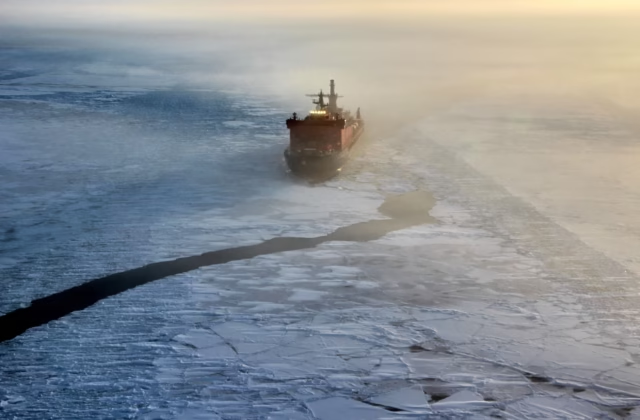
China is increasingly looking toward the Northern Sea Route (NSR) along Russia’s Arctic coastline as a potential alternative trade corridor, particularly as geopolitical tensions and disruptions around traditional maritime chokepoints increase.
The latest development is particularly significant: Chinese shipping company Sea Legend has launched a regular cargo service through the Arctic, connecting China with the United Kingdom. The company says its Arctic service can make the journey between Ningbo-Zhoushan and Felixstowe in around 18 days.
For businesses, investors and global supply-chain managers, this raises a much bigger question:
Could the Arctic become the next major battleground for global shipping, energy and trade?
What Is the “Ice Silk Road”?
The term Ice Silk Road refers to China’s interest in developing Arctic shipping routes as part of its broader international trade strategy.
China has previously described its Arctic ambitions through the concept of a Polar Silk Road, linking Asian and European markets through northern waters.
The most important corridor is the Northern Sea Route, which runs along Russia’s northern coastline between the Atlantic and Pacific regions.
The attraction is straightforward:
China → Arctic → Northern Europe
can potentially be substantially shorter than:
China → Indian Ocean → Suez Canal → Mediterranean → Northern Europe.
The Northern Sea Route stretches roughly 5,500 km along Russia’s Arctic coast, and its shorter geography can reduce transit times for certain Asia-Europe shipments.
Why China Is Looking North
The Arctic strategy is about much more than saving a few days of shipping time.
China is heavily dependent on international trade and imported energy.
That makes the security of maritime routes strategically important.
Traditional shipping routes can be exposed to:
- Military conflicts
- Sanctions
- Piracy
- Political disputes
- Congestion
- Canal disruptions
- Rising insurance costs
The disruptions experienced around major maritime chokepoints have made companies increasingly interested in alternative routes.
The Arctic therefore represents a potential diversification strategy for China’s supply chains.
The Hormuz Connection
The renewed interest in Arctic shipping comes at a particularly important moment for global trade.
The Strait of Hormuz remains one of the world’s most important energy chokepoints, while conflicts and disruptions elsewhere have demonstrated how quickly geopolitical events can affect shipping costs.
For China, the lesson is simple:
The more alternative trade routes available, the less dependent the country is on any single maritime corridor.
The Arctic cannot replace Hormuz or the Suez Canal today.
But it could become an additional strategic option.
China and Russia: A Powerful Arctic Partnership
China’s Arctic ambitions are closely connected to Russia.
Russia controls much of the Northern Sea Route and operates a major icebreaker fleet through state nuclear company Rosatom.
For Moscow, the route offers an opportunity to increase exports of oil, LNG and other resources to Asian markets.
For Beijing, Russia provides access to an Arctic corridor that could eventually support more trade between China and Europe.
The relationship therefore has a strong economic logic:
Russia provides geography, Arctic infrastructure and energy resources.
China provides shipping capacity, capital, manufacturing and a huge consumer market.
Recent developments suggest that relationship is becoming increasingly commercial.
Russia’s crude exports to Asia through the Northern Sea Route have accelerated in 2026, with seven shipments totaling around 6 million barrels reported as already en route by August 11—nearly half the volume transported through the route during the entire 2025 season.
Arctic Shipping Is No Longer Just About Oil and Gas
Energy remains a major part of Arctic shipping.
But the long-term opportunity could be much broader.
Potential cargoes include:
- Electric vehicles
- Solar equipment
- Industrial machinery
- Consumer products
- LNG
- Crude oil
- Minerals
- Metals
- Critical raw materials
The first regular Chinese container service is particularly important because container shipping is much closer to the traditional global trade model than resource transportation.
If regular container services become commercially reliable, the Arctic could gradually move from being primarily an energy-export corridor toward becoming a broader trade route.
The Big Advantage: Time
One of the strongest arguments for Arctic shipping is speed.
The new Chinese Arctic service is targeting approximately 18 days between Ningbo-Zhoushan and Felixstowe.
Other estimates put Arctic journeys at significantly shorter distances than traditional Suez routes, although the exact savings depend heavily on the origin, destination, vessel, weather and ice conditions.
That could be valuable for industries where speed matters.
Think about products with:
- Shorter product cycles
- High inventory costs
- Time-sensitive delivery requirements
- Rapid technological obsolescence
For those businesses, shaving days off transportation could have a meaningful economic value.
But There Is a Major Problem: The Arctic Is Not a Normal Shipping Route
The biggest mistake investors could make is assuming that a shorter route automatically means a cheaper route.
It doesn’t.
Arctic shipping comes with major additional costs.
❄️ Ice Conditions
Ships may require ice-class construction and, depending on conditions, assistance from icebreakers.
💰 Insurance
Extreme weather and limited rescue infrastructure can increase insurance costs.
🛰️ Infrastructure
Ports, communications, search-and-rescue capabilities and emergency infrastructure remain far less developed than along major southern trade corridors.
🌡️ Climate Uncertainty
Melting ice makes navigation possible in areas that were previously difficult to access, but Arctic weather remains highly unpredictable.
⚖️ Geopolitical Risk
Russia’s control of the Northern Sea Route creates a major political consideration for international shipping companies.
The International Chamber of Shipping notes that Arctic shipping offers potentially shorter routes but remains constrained by operational, infrastructure and geopolitical challenges.
The Environmental Paradox
There is an extraordinary contradiction at the heart of the Ice Silk Road.
Climate change is helping make Arctic shipping easier.
But increased Arctic shipping could also create additional environmental risks.
Greater vessel traffic means greater potential exposure to:
- Oil spills
- Black carbon emissions
- Noise pollution
- Marine ecosystem disruption
- Accidents in fragile environments
Black carbon is particularly concerning because particles deposited on snow and ice can absorb sunlight and contribute to faster warming.
So the same environmental transformation that is opening Arctic waters could also create pressure for stricter environmental rules.
Could the Arctic Challenge the Suez Canal?
Not immediately.
The Suez Canal remains vastly more established, with:
- Major ports
- Global logistics networks
- Predictable navigation
- Large container volumes
- Established insurance markets
- Extensive infrastructure
The Northern Sea Route is still a niche corridor compared with conventional global shipping.
Industry analysts have cautioned that Arctic shipping remains commercially limited despite growing interest.
But the important point is not that the Arctic will replace Suez.
It is that global shipping companies may increasingly have another option.
And in geopolitics, optionality has enormous value.
What Does This Mean for Global Energy Markets?
The Arctic could become increasingly important for energy transportation.
Russia is already using the Northern Sea Route to move crude oil and LNG toward Asian buyers.
If Arctic energy exports increase, China could gain another source of imported energy that is geographically closer than some traditional supply chains.
For global energy markets, that could eventually affect:
- Russian oil flows
- Asian crude supply
- LNG transportation
- Shipping rates
- European energy security
- Global oil trade patterns
The development of Russia’s Arctic energy projects is therefore closely linked to the future of the Northern Sea Route.
What Does It Mean for Investors?
The emergence of Arctic shipping could create long-term investment themes across several industries.
🚢 Shipping
Demand for ice-class vessels could increase.
⚓ Ports
Northern ports may require substantial investment if trade volumes grow.
🛢️ Energy
Arctic oil and LNG projects could become more commercially significant.
⛏️ Mining
The region’s critical mineral potential could attract additional investment.
🛰️ Technology
Satellite communications, navigation, weather forecasting and Arctic monitoring could become increasingly valuable.
🛡️ Defense
As commercial activity increases, governments are likely to pay greater attention to Arctic security.
Why the US and Europe Are Watching
China’s growing Arctic presence has major geopolitical implications.
The Arctic is becoming increasingly important not just for trade but also for:
- National security
- Critical minerals
- Energy
- Shipping
- Military positioning
- Infrastructure
The United States, Canada and European countries are therefore increasing their focus on Arctic infrastructure and strategic capabilities.
The region could become another arena where China, Russia and Western economies compete for economic and strategic influence.
Could the Ice Silk Road Change Globalization?
This may ultimately be the most important question.
Globalization has historically depended on a relatively small number of major trade corridors.
The Suez Canal, Strait of Malacca, Strait of Hormuz and Panama Canal are all strategically important.
The Arctic could add another major option.
That doesn’t mean global trade will suddenly move north.
Instead, businesses may gradually adopt a multi-route strategy:
Suez + Cape of Good Hope + Arctic + regional corridors
Such diversification could make global supply chains more resilient to individual geopolitical disruptions.
The Bottom Line
China’s Ice Silk Road is no longer simply a futuristic concept.
The launch of regular Chinese Arctic cargo services, combined with Russia’s growing use of the Northern Sea Route for energy exports, suggests that the Arctic is slowly becoming a real commercial corridor.
But investors should avoid the hype.
The Arctic remains expensive, seasonal, politically sensitive and environmentally fragile.
For now, it is unlikely to replace the Suez Canal or other major global shipping routes.
The bigger story is what happens over the next decade.
If Arctic infrastructure improves, ice-class fleets expand and geopolitical demand for alternative trade routes remains strong, the Ice Silk Road could become one of the most important new logistics corridors in the global economy.
And for China, that could mean something even more valuable than faster shipping:
greater control over the routes connecting its economy to the rest of the world.
Frequently Asked Questions
What is China’s Ice Silk Road?
The Ice Silk Road refers to China’s growing interest in Arctic shipping routes, particularly the Northern Sea Route along Russia’s Arctic coastline, as part of its broader Polar Silk Road strategy.
Is the Northern Sea Route faster than the Suez Canal?
For some China-Europe routes, yes. The Arctic can significantly shorten the distance, although actual journey times depend on ice, weather, vessel type and other operational conditions.
Can the Arctic replace the Suez Canal?
Not currently. Arctic shipping remains much smaller and faces major infrastructure, seasonal, insurance, environmental and geopolitical challenges.
Why is China interested in Arctic shipping?
China can potentially reduce transit times, diversify its supply chains and gain another route to European markets while reducing dependence on traditional maritime chokepoints.
Why is Russia important to the Ice Silk Road?
Russia controls much of the Northern Sea Route and provides important Arctic infrastructure, navigation support and access to energy resources.
Will Arctic shipping affect oil prices?
Potentially. Greater Arctic energy exports could influence regional supply chains and shipping patterns, although global oil prices remain driven by much broader supply-and-demand factors.
About TheBusinessNow
TheBusinessNow covers global business, finance, technology, markets, geopolitics and economic trends, providing readers with original analysis of the events shaping the world economy.
Disclaimer: This article is for informational purposes only and does not constitute financial, investment or trading advice. Geopolitical events can change rapidly, and market reactions are unpredictable.
Keep reading
Related Articles
 Crypto
₿ Bitcoin Breaks Above $72,000: Why Trump’s Crypto Push Is Sending Crypto Stocks Higher
Bitcoin’s $72,000 Move Is Bigger Than Bitcoin A typical crypto headline would be: Bitcoin jumps above $72,000. But that misses the most important part of today’s move. The interesting part is the simultaneous rally in: Bitcoin ↓ Coinbase ↓ Strategy ↓ Circle ↓ Robinhood ↓ Bitcoin miners ↓ Crypto infrastructure That tells us investors aren’t...
 Markets
U.S. Treasury Doubles Bond Buybacks: Why Markets Are Still Worried About Rising Yields
The Treasury Just Sent Two Messages to Wall Street At first glance, this looks like a straightforward market-support operation. Treasury says: We want to improve liquidity in longer-dated Treasury securities. Investors hear: Washington is increasingly concerned about the rise in long-term borrowing costs. And that second interpretation is what makes this story important. The Treasury...
 Commodities
Oil Nears $95: Could the Iran War Trigger a New U.S. Inflation Shock?
Oil at $95 Is Not the Real Story A crude-oil headline is easy to write: “Oil prices rise as Iran tensions escalate.” Reuters, Bloomberg, CNBC and WSJ can publish that story within minutes. But for TheBusinessNow, that isn’t enough. The bigger question is: What happens to the American economy if oil stays near $95 —...
Comments (0)