
Iran Considers European Role in Strait of Hormuz—What It Means for Global Oil Prices
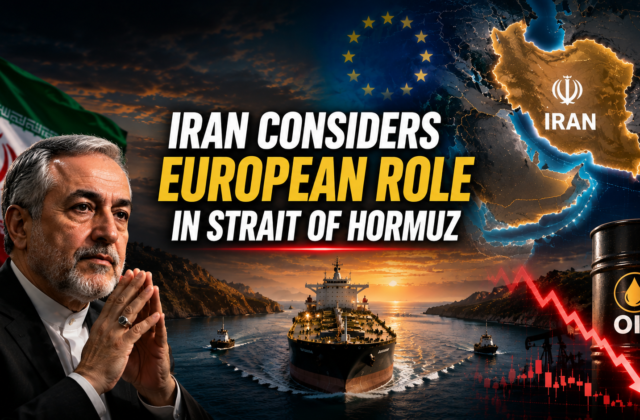
Iran Considers European Role in Strait of Hormuz — What It Means for Global Oil Prices Iran is weighing a possible European role in efforts to restore shipping through the Strait of Hormuz, adding another layer to increasingly complex negotiations over the strategic oil chokepoint. Any arrangement that gives European countries a role in securing...
Mac John
Aug 4, 2026 · 3 min Read
Key Highlights
- 🛢️ The Strait of Hormuz remains at the center of negotiations over global energy security.
- 🇮🇷 Iran is seeking greater control over how vessels enter and leave the waterway under a proposed temporary arrangement.
- 🇴🇲 Oman is involved in mediating and designing a possible transit mechanism.
- 🇪🇺 European involvement could provide additional diplomatic and maritime-security support, but the precise role remains unsettled.
- 🚢 Shipping traffic through Hormuz remains far below normal levels, according to recent vessel-tracking data.
- 📉 Oil prices have reacted sharply to changing expectations about a potential reopening.
- ⚠️ A failed agreement could quickly restore the geopolitical premium in crude prices.
Iran Considers European Role in Strait of Hormuz — What It Means for Global Oil Prices
Iran is weighing a possible European role in efforts to restore shipping through the Strait of Hormuz, adding another layer to increasingly complex negotiations over the strategic oil chokepoint. Any arrangement that gives European countries a role in securing or monitoring maritime traffic could have major consequences for crude prices, tanker movements, insurance costs and global energy markets.
The development comes as Iran and Oman work on a proposed temporary mechanism for reopening the waterway. Under the arrangement currently being discussed, ships could enter the Persian Gulf through an Iranian-controlled route and leave through an Omani-controlled route. Iran is also seeking greater control over inbound traffic and oversight of outbound movements.
The European angle is particularly significant because the EU has repeatedly demanded freedom of navigation through Hormuz while simultaneously looking for ways to reduce Europe’s vulnerability to disruption at the chokepoint. The EU has also said Europe is ready to play a role in regional diplomacy and maritime security.
But there is an important distinction: a European role does not yet mean a finalized European-Iranian agreement. Current reporting points to ongoing negotiations, not a completed international arrangement.
What Is Iran Considering?
The latest negotiations are not simply about whether the Strait of Hormuz should reopen.
They are increasingly about who controls the movement of ships once traffic resumes.
According to Reuters, Iran has moved away from an earlier demand for complete control of traffic in both directions. Under the proposal now being discussed, Iran would control inbound shipping while maintaining oversight of outbound movements, with Oman providing exit clearance.
That creates a potentially workable mechanism for getting vessels moving again, but it also raises a much bigger question:
Can international shipping operate reliably if Iran retains a significant operational role in the waterway?
For oil traders, that question matters almost as much as whether the Strait technically reopens.
A waterway can be legally open but commercially difficult to use if shipping companies face uncertainty over permissions, security, insurance or fees.
Where Does Europe Fit Into the Picture?
Europe’s potential involvement is significant because European governments have already been closely engaged with the Hormuz crisis.
The EU has publicly called for free and safe passage through the Strait and has rejected actions that interfere with freedom of navigation.
In June, European Commission President Ursula von der Leyen said Europe was ready to play its part following an earlier U.S.-Iran agreement and emphasized that freedom of navigation should be restored without tolls.
The EU has also imposed measures against individuals and entities it says were involved in actions threatening navigation through Hormuz.
That creates an unusual diplomatic position.
Europe wants the Strait open because European consumers and industries depend on stable energy markets.
At the same time, European governments do not want an arrangement that effectively legitimizes unilateral control over international maritime passage.
Why a European Role Could Matter for Oil Prices
The biggest potential benefit of European participation would be greater confidence among shipping companies and energy traders.
Oil prices don’t respond only to physical barrels.
They also respond to expectations.
If traders believe tankers can safely move through Hormuz for weeks and months, the risk premium embedded in crude prices can decline.
But if there is uncertainty over whether vessels will be stopped, inspected, charged or diverted, traders may continue pricing a significant geopolitical premium into oil.
That means European participation could potentially help create a clearer framework for shipping.
The key word is confidence.
Hormuz Is More Than an Oil Story
The Strait of Hormuz is often discussed as an oil chokepoint, but its importance extends across the energy system.
The waterway is a major route for:
- Crude oil
- Refined petroleum products
- Liquefied natural gas
- Petrochemicals
- Other bulk commodities
The disruption therefore affects far more than gasoline prices.
The UK government has described Hormuz as a primary route for global energy exports and warned that disruption can have immediate consequences for global supplies, prices and economic stability.
That helps explain why governments outside the Middle East have such a strong interest in the negotiations.
Oil Markets Are Watching Every Diplomatic Signal
Crude markets have become extremely sensitive to developments surrounding Hormuz.
When officials suggested that a deal to reopen the waterway could be imminent, oil prices moved sharply lower. WTI fell toward the high-$70s and Brent moved toward the low-$80s in Tuesday trading.
But the market response can change quickly.
When doubts emerged over whether a deal would actually materialize, oil prices rebounded.
This creates a highly unusual trading environment in which a single diplomatic statement can move crude by several percentage points.
For investors, that means today’s oil price may not necessarily represent the market’s view of long-term supply and demand.
It may instead reflect the probability assigned to a Hormuz reopening.
The European Factor Could Affect the Risk Premium
Suppose European governments become directly involved in a maritime-security framework.
That could potentially reduce uncertainty in several areas.
Shipping Permissions
Operators could have greater clarity over which routes vessels are permitted to use.
Maritime Security
International participation could provide greater confidence that commercial vessels have access to recognized security arrangements.
Insurance
If shipping risks become more predictable, insurance markets could eventually become less restrictive.
Tanker Availability
More predictable operating conditions could encourage more tankers to return to Gulf routes.
Physical Oil Supply
Once vessels begin moving consistently, more crude and petroleum products can reach international buyers.
That sequence is important.
Diplomacy → shipping confidence → tanker movements → physical supply → oil prices
The effect on crude prices could therefore take time rather than happen instantly.
Why Shipping Data Matters More Than Headlines
Recent vessel-tracking data shows why investors should be cautious about assuming that diplomatic progress equals a full reopening.
Reuters reported that only six vessels — three tankers and three bulk carriers — passed through the Strait on Monday, compared with seven the previous day. The vessels recorded in the data were using the Iranian route.
That is a crucial market indicator.
A genuine reopening should eventually show up in physical traffic.
If tanker numbers rise consistently, it would provide stronger evidence that energy flows are normalizing.
If traffic remains extremely limited despite political announcements, traders may conclude that the operational risks remain unresolved.
Iran’s Control Proposal Is the Biggest Complication
The emerging framework creates a difficult balance.
Iran wants security influence over the waterway.
Other countries want internationally recognized freedom of navigation.
Those positions are not automatically compatible.
Reuters reported that Iran rejected an earlier Omani proposal based on equal transit division because of unresolved security concerns.
That means negotiations are not merely technical.
They involve sovereignty, security, international maritime law and the political balance between Iran, Oman, the United States and other countries.
European participation could potentially help bridge some of those differences — but it could also expose new disagreements if European governments reject Iranian control mechanisms.
What Happens to Oil If Hormuz Reopens?
A stable reopening would likely remove some of the supply-risk premium from crude.
But that does not automatically mean oil prices collapse.
There are several reasons.
First, inventories have been depleted during the disruption.
Second, producers and consumers may need time to restore normal logistics.
Third, shipping companies may initially remain cautious.
Fourth, the market may continue to price some geopolitical risk even after the Strait reopens.
The European Central Bank previously warned that oil prices could remain elevated if Hormuz reopened only gradually, highlighting the difference between a formal reopening and a return to normal energy flows.
That distinction could become one of the most important issues for the oil market in the coming weeks.
What If the European Effort Fails?
The downside scenario is straightforward but potentially severe.
If negotiations break down and shipping remains restricted, crude markets could once again price a larger supply disruption.
That could push:
Oil prices higher → gasoline prices higher → transport costs higher → inflation pressure higher
Energy-intensive industries could face increased operating expenses.
Airlines and transportation companies could come under pressure.
Oil producers, meanwhile, could benefit from higher crude prices — although their share prices would also remain exposed to geopolitical risk.
The broader stock market could suffer if higher energy prices begin to threaten consumer spending and corporate margins.
Could Europe Help Stabilize Global Energy Prices?
Potentially, but Europe cannot reopen Hormuz by itself.
The waterway touches Iranian and Omani territorial waters, while its international shipping role gives the issue a much wider geopolitical dimension.
The EU’s own policy emphasizes diplomacy, freedom of navigation and cooperation with regional and international institutions.
A credible European role could therefore be more useful as part of a multilateral arrangement than as a unilateral European operation.
That could involve diplomatic monitoring, maritime coordination, information sharing and cooperation with organizations responsible for shipping safety.
What It Means for Inflation
Oil is one of the most important channels through which geopolitical events can affect consumer prices.
A sustained rise in crude can increase costs across:
- Transportation
- Aviation
- Logistics
- Manufacturing
- Chemicals
- Agriculture
- Consumer goods
A successful Hormuz reopening could therefore help reduce some inflation pressure.
But central banks would need to see sustained changes in energy prices before concluding that the inflation outlook had materially improved.
One or two days of falling crude prices would not be enough.
What It Means for the Federal Reserve
For the Federal Reserve, the Hormuz situation creates a potential policy complication.
If oil remains elevated, headline inflation could stay under pressure.
If energy prices fall sharply after a durable reopening, inflation expectations could improve.
That could make monetary policy somewhat easier to manage.
But the Fed’s decisions depend much more broadly on inflation, employment, wages, consumer spending and economic growth.
Therefore, Hormuz is best viewed as a major external inflation variable, not a standalone trigger for Fed policy.
What It Means for European Consumers
Europe has another reason to care about the outcome.
The region has spent years trying to reduce dependence on vulnerable energy supply routes.
The European Council has specifically discussed reducing the bloc’s vulnerability to Hormuz through energy-supply diversification.
A prolonged disruption could therefore accelerate investment in:
- Alternative oil suppliers
- LNG infrastructure
- Strategic reserves
- Pipeline connections
- Renewable energy
- Energy-efficiency measures
In other words, the current crisis could influence Europe’s energy strategy long after the immediate shipping problem disappears.
Three Oil-Market Scenarios
🟢 Scenario 1 — European-Backed Maritime Arrangement Succeeds
A workable agreement is reached, vessels begin moving consistently and shipping confidence improves.
Potential oil impact: downward pressure on Brent and WTI as the geopolitical premium fades.
🟡 Scenario 2 — Partial Reopening
Some tankers resume transit but the system remains subject to restrictions, inspections or security concerns.
Potential oil impact: prices remain volatile because the market still demands a risk premium.
🔴 Scenario 3 — Negotiations Collapse
Iran maintains restrictions, shipping remains disrupted and military tensions increase.
Potential oil impact: crude could rise sharply as traders price renewed supply risks.
What Investors Should Watch Now
The most important indicators are no longer simply diplomatic statements.
Watch for:
1. Tanker traffic through Hormuz
A sustained increase would be stronger evidence of reopening.
2. Brent crude
The market’s immediate measure of changing supply risk.
3. WTI crude
Useful for tracking U.S. crude-market expectations.
4. Shipping insurance costs
A critical indicator of whether commercial operators actually view the route as safe.
5. Iranian and Omani statements
These can reveal whether a proposed mechanism has political backing.
6. European government involvement
Actual participation would matter more than general diplomatic support.
7. Gulf producer exports
Rising physical exports would confirm that reopening is translating into supply.
The Bigger Global Oil Story
The Hormuz crisis has exposed a vulnerability that extends beyond the current conflict.
The global oil market depends heavily on a small number of maritime chokepoints.
When one of those routes becomes unavailable, alternative supply routes cannot necessarily replace the lost capacity immediately.
That is why governments are now thinking beyond simply reopening Hormuz.
The longer-term question is:
How can the global energy system become less dependent on a single strategic waterway?
Europe is already discussing diversification of energy routes.
For oil-consuming economies, that could become one of the most important lessons from the crisis.
Final Thoughts
Iran’s consideration of a broader international role in managing or securing Strait of Hormuz traffic could become a major turning point for global energy markets.
The immediate negotiations remain centered on Iran and Oman, with the proposed mechanism involving Iranian-controlled entry and Omani-controlled exit routes.
Europe, meanwhile, has already made clear that it wants freedom of navigation restored and has indicated that it is prepared to contribute to regional efforts.
But a European role should not be confused with a finalized deal.
The real test will be physical.
Will tankers begin moving through Hormuz consistently? Will shipping companies accept the security arrangements? Will insurance costs fall? And will Gulf oil actually begin reaching international markets at normal volumes?
Those answers will ultimately matter more to oil prices than diplomatic headlines.
For now, the market remains caught between two powerful forces:
Hope for a reopening — and fear that the geopolitical risk has not disappeared.
❓ FAQs
Why is Europe interested in the Strait of Hormuz?
Europe depends on stable global energy markets and has repeatedly called for safe and unrestricted navigation through Hormuz. The EU is also seeking to reduce its vulnerability to disruptions at the chokepoint.
Is Europe officially taking control of the Strait of Hormuz?
No. Current reporting does not establish that Europe is taking control of the Strait. European involvement is better understood as a potential diplomatic or maritime-security role within a broader international arrangement.
What is Iran proposing for Hormuz?
Reuters reports that Iran is seeking control over inbound shipping and oversight of outbound traffic under a temporary arrangement being negotiated with Oman.
Why does the Strait of Hormuz affect oil prices?
The Strait is a major route for energy shipments. Restrictions can reduce available supply and increase the geopolitical risk premium in crude prices.
Could oil prices fall if Hormuz reopens?
Yes, particularly if reopening is stable and tanker traffic returns toward normal levels. However, prices may not immediately return to pre-crisis levels because inventories, shipping costs and geopolitical risks can take time to normalize.
Could oil prices rise again?
Yes. A breakdown in negotiations, renewed attacks or continued restrictions on shipping could push crude prices higher.
What should oil investors watch?
Tanker traffic, Brent and WTI prices, shipping insurance, Gulf exports, Iranian and Omani statements, and evidence of sustained commercial passage through Hormuz are among the most important indicators.
📰 About The Business Now
The Business Now delivers coverage of global business, finance, commodities, energy, geopolitics, stocks, technology and economic developments with a focus on factual reporting and market impact.
🪙 Check Live Gold Prices
Track Gold, Silver, Platinum and Palladium prices, historical charts, calculators and daily market updates at:
🌐 External Resources
Keep reading
Related Articles
 Crypto
₿ Bitcoin Breaks Above $72,000: Why Trump’s Crypto Push Is Sending Crypto Stocks Higher
Bitcoin’s $72,000 Move Is Bigger Than Bitcoin A typical crypto headline would be: Bitcoin jumps above $72,000. But that misses the most important part of today’s move. The interesting part is the simultaneous rally in: Bitcoin ↓ Coinbase ↓ Strategy ↓ Circle ↓ Robinhood ↓ Bitcoin miners ↓ Crypto infrastructure That tells us investors aren’t...
 Markets
U.S. Treasury Doubles Bond Buybacks: Why Markets Are Still Worried About Rising Yields
The Treasury Just Sent Two Messages to Wall Street At first glance, this looks like a straightforward market-support operation. Treasury says: We want to improve liquidity in longer-dated Treasury securities. Investors hear: Washington is increasingly concerned about the rise in long-term borrowing costs. And that second interpretation is what makes this story important. The Treasury...
 Commodities
Oil Nears $95: Could the Iran War Trigger a New U.S. Inflation Shock?
Oil at $95 Is Not the Real Story A crude-oil headline is easy to write: “Oil prices rise as Iran tensions escalate.” Reuters, Bloomberg, CNBC and WSJ can publish that story within minutes. But for TheBusinessNow, that isn’t enough. The bigger question is: What happens to the American economy if oil stays near $95 —...
Comments (0)